
Your book can hit a bestseller list and still die alone on an Amazon page.
That happens when the launch becomes more important than the reader. You can buy a campaign, climb a tiny category for an afternoon, and collect a screenshot. Word of mouth asks a harder question: did the book change anything worth repeating?
And let’s be real: calling a book a “better business card” sets the bar somewhere near the trash can.
In the conversation below and the article that follows, AJ Harper and I will show you how to write a book around a reader promise, build a transformational outline, use feedback without losing your voice, and give the book a life longer than launch week.
A business card book serves the author
I understand the temptation. A book creates authority. It can open a stage, start a conversation, and help a future client understand your work before you meet.
Those are receipts. They can’t be the reason each chapter exists.
When I wrote the first self-published version of Killing Sacred Cows, I was trying to prove I knew something. A publisher later told me I’d written for one type of reader: the analytical one. I had information. I was missing connection, entertainment, and hope.
We rewrote the whole book.
The published version came out in 2008. More than fifteen years later, readers still recommend it. The work has earned thousands of organic reviews and started conversations I could never have purchased with an ad.
A book earns a long life when the reader becomes the reason another reader finds it.
That’s relationship capital in motion. The book carries mental capital into a home, onto a flight, or into a conversation. When the idea helps, the reader carries it farther.
How to write a book around one clear promise
AJ begins book development with the reader, a transformational core message, and the promise of the book.
Most outlines organize information. Spoons go with spoons. Knives go with knives. The chapters look tidy, while the reader has no reason to move from one drawer to the next.
A transformational outline follows the reader instead. Where are they now? What do they misunderstand? What can they see or do after this chapter that they couldn’t before?
Write the promise in one sentence:
This book helps [specific reader] move from [current struggle] to [useful change] by [distinct method].
If that sentence feels foggy, more chapters won’t rescue it. Spend time on the promise before you spend months on pages.
For another way to name the knowledge only you can teach, read about your Intellectual Property DNA. Your lived process is often more useful than the topic you think sounds impressive.
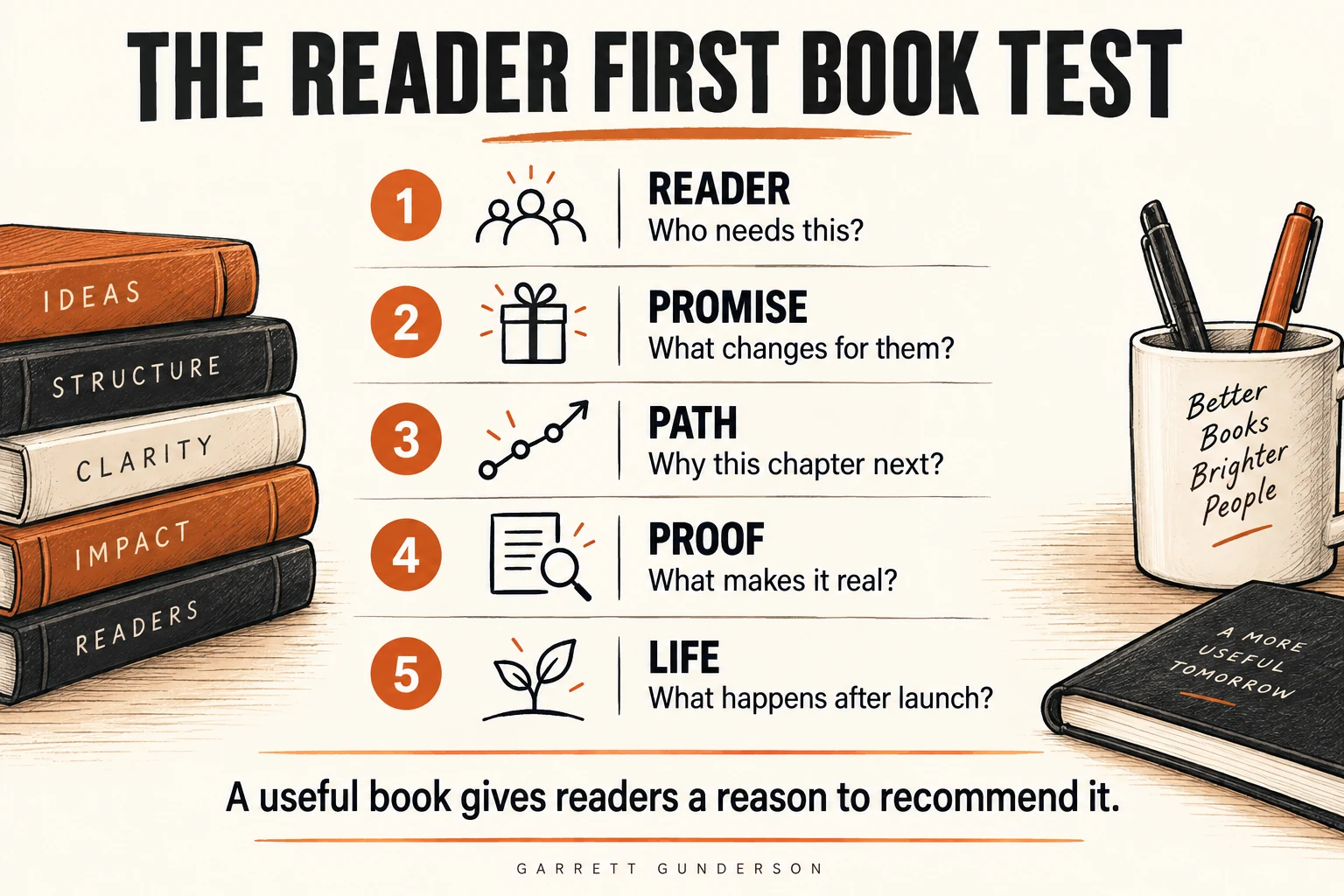
Use the five part Reader First Book Test
Before you draft another chapter, put the book through five tests. Give each answer one sentence. Clarity wins.
| Test | Question | Warning sign |
|---|---|---|
| Reader | Who has this problem badly enough to keep reading? | “Everyone” is the audience. |
| Promise | What useful change does the book deliver? | The promise is “share my story.” |
| Path | Why does chapter two follow chapter one? | Chapters are a pile of related essays. |
| Proof | Which story, result, or example makes the idea real? | Claims depend on credentials alone. |
| Life | How will you serve the book after release? | The plan ends on launch day. |
This is the Reader First Book Test. It protects the reader from your ego and protects you from spending a year polishing a business card.
If the core idea still feels slippery, use the free Idea Optimizer to pressure test the problem, person, and next move before you build the outline.
Develop the book before the draft gets expensive
AJ’s fourteen week workshop spends the first five weeks on development. Writers then get four solid weeks to draft. The final five weeks focus on chapters and editing.
Five weeks before the real drafting begins.
That ratio makes impatient writers uncomfortable. It also prevents a manuscript from becoming a teardown. You discover the wrong reader, a soft promise, or a missing chapter while the fix is still a sticky note.
Think about building a house. Learning construction while pouring the foundation would be a wild plan. First time authors are learning the craft while building the thing. A clear plan and a co-creator reduce wasted walls.
You can still write a sloppy first draft. In fact, please do. Sloppy pages can be edited. A confused promise keeps producing confused pages.
Make feedback a co-creation process
Feedback feels personal because a book carries the best of who you are. That vulnerability can make you defend every sentence.
AJ uses a feedback protocol. Choose the right readers. Ask the same useful questions. Look for patterns. One reader may be an outlier. Five readers stumbling in the same chapter are giving you information.
During Money Unmasked, we built a reader group. One chapter I wasn’t sure we’d keep became the favorite. We moved it earlier while protecting the Cycle of Creation that held the book together.
The readers became co-creators. They wanted the work to win because they’d helped shape it.
This is the same reason I value finding your voice over sounding polished. Useful feedback sharpens your message. Empty praise keeps the weak chapter comfortable.
Your voice comes from reps, not a prompt
I used to take six hours to write a blog post. After years of writing, coaching, courses, and candid editing, I can finish a 2,500 word piece in about 90 minutes to two hours.
On a flight home, tired, I wrote 1,000 words in an hour.
Speed showed up after the craft. I learned my process. I found the rhythm of a sloppy first draft and a demanding edit. I stopped asking the first page to prove I was a writer.
Technology can help with research, organization, or a rough structure. Handing away the thinking costs more than time. Writing clarifies your principles. It reveals where your experience has a hole. It gives you confidence you can carry into the next book, stage, or conversation.
That human work is the asset.
Plan for the life of the book
One author told AJ the reason his book kept selling was simple: he stayed with it for ten years.
What Would the Rockefellers Do? came out in 2016. Years later, different editions have held several spots in the top ten of its Amazon categories. I never built the strategy around one launch week. The book kept finding readers because the idea kept helping.
A book can catch fire in year three or four. It can lead to a speech, a relationship, a licensing idea, or a conversation you couldn’t predict. Intellectual property builds financial capital through mental capital multiplied by relationship capital.
For the wider asset strategy, read how to turn ideas into income and legacy. The book is one format. The value can keep moving through courses, talks, tools, and people who teach the idea to somebody else.
Build the first page from the reader backward
- Take one hour this week. Write the five answers from the Reader First Book Test on a single page.
- Then write ten possible chapters on sticky notes. Under each one, finish this sentence: After this chapter, the reader can…
- Throw away any chapter that exists only to show how much you know. Move the chapters until the change makes sense. Share the page with one candid reader who matches the audience.
You don’t have to sound brilliant. You get to be useful.
When the promise works, writing becomes an act of service. Your voice gets clearer. The reader sees a path. Word of mouth becomes the receipt.
In prosperity,
Garrett Gunderson
Read a book built to challenge the reader
Get a free copy of Killing Sacred Cows 2.0. Use it as a working example of a clear promise, reader-first myths, lived stories, and a message that kept earning word of mouth.
Frequently Asked Questions
What comes first when writing a nonfiction book?
Start with a specific reader, the change they want, and one clear promise. A transformational outline follows the reader’s path instead of grouping related information into a tidy pile.
How long does it take to write a good book?
The timeline depends on the idea and your experience. Spend enough time developing the promise and outline before drafting. A slower first month can prevent months of rebuilding later.
How do I get useful feedback on a manuscript?
Choose readers who match the audience, ask each one the same questions, and look for patterns. Treat feedback as information. Keep your voice while fixing places where several readers lose the path.
Is a book a good business card?
A book can create authority and relationships, yet a business-card mindset puts the author first. Write something useful enough that a reader wants to recommend it. Authority follows service.