
I started from nothing in my 20s, in a coal mining town, with zero head start. By 27, I was a multi-millionaire. I’m in my 40s now, and I’ve watched enough people get their 20s wrong to know what matters.
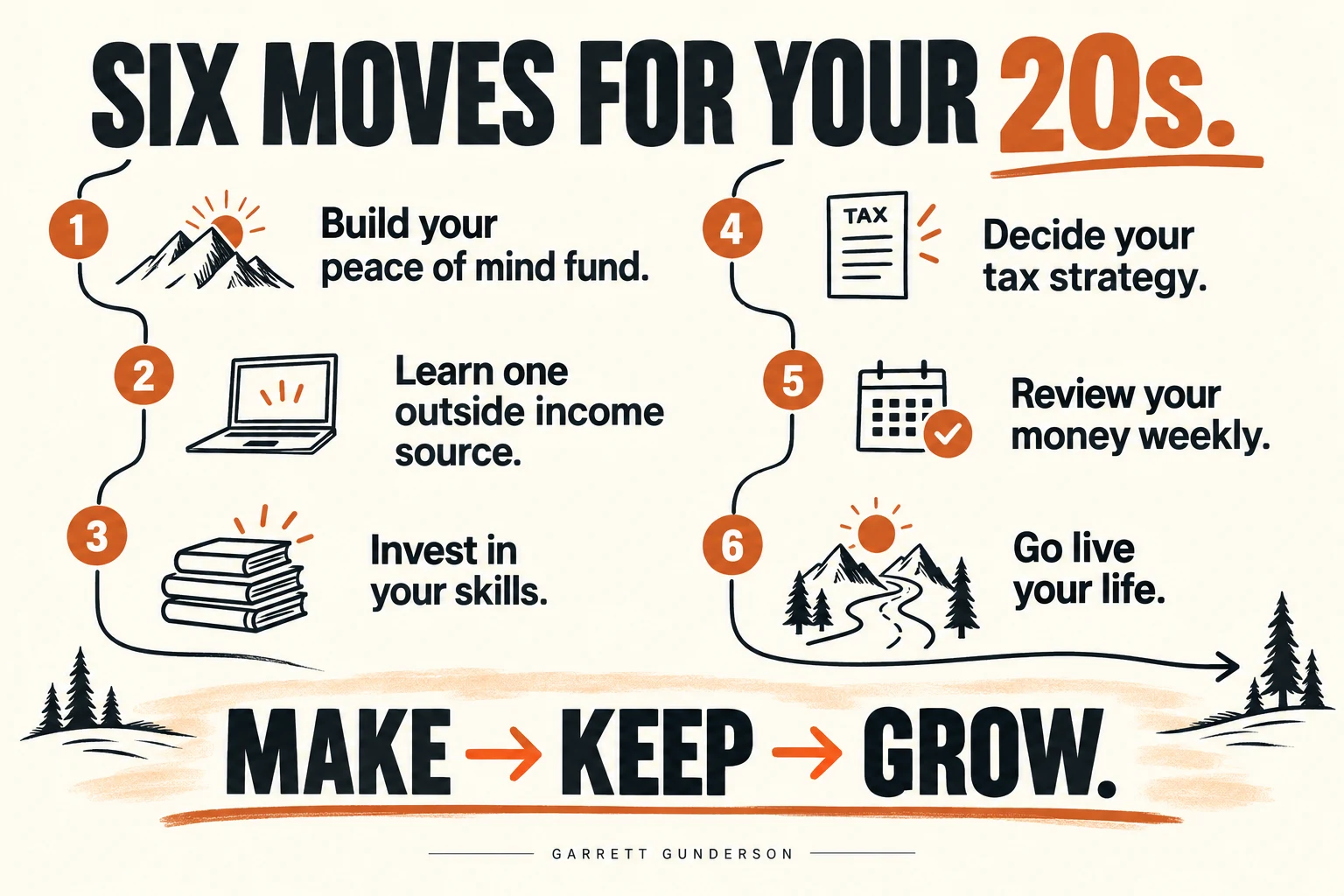
The six things: build a peace of mind fund, learn one cash flow income source outside your business, invest in your own skills before the market, decide the pre-tax question on purpose, check your money weekly, and go live your life while it’s cheap to do.
Here’s each one, and the mistakes I made learning them.
Why does liquidity beat net worth in your 20s?
Boring, I know, but critical.
You’re in your 20s and something unexpected happens. Your business cash flow is tight, a medical bill lands, a family member gets sick.
Who cares what you’re worth on paper? How much can you get to, now?
In 2008 I thought I was Midas. From the outside I was doing everything right: hustling, taking risk, growing. What I was really doing was redlining, pushing so hard and reinvesting so fast that I was vulnerable.
I was overleveraged, which just means I’d borrowed so much that every dollar coming in was already spoken for. Over 100 properties. A payment on 45 percent of a 45,000 square foot building. Payroll.
And the Great Recession of 2008 hitting all of it at once. Asset rich, cash poor.
During downturns, net worth is relatively worthless. The real game is access to cash and cash flow.
What happens when every dollar is locked into growth and none of it is liquid? Pain. Grey hair. Weight gain. Stress. Self-judgement.
And it’s not just an economy or stock market problem. Money locked in a retirement account or in home equity has the same issue. You can’t buy groceries with a 401(k) statement.
The move: build a two column sheet. Locked money on the left, liquid on the right. Set a target of six months of expenses in the liquid column, and fund it before you raise your investment contributions.
I call it the peace of mind fund. I never call it an emergency fund, because nobody builds toward something called an emergency.
How do you build income outside your business?
I’m not talking about multiple streams of income, so many you can’t pay attention to them. I’m talking about one cash flow investment outside of your business.
The smartest thing you can do is build a second source of cash flow. Here’s where I’d tell you to look.
Intellectual property, which is anything that lives on after you’ve done the work once. The platforms and the AI support for systems and research already exist, so the old barriers are gone. Bring your own brain and creativity. Start with a post, a consumer awareness white paper, then maybe a book. In today’s world, self-publishing is easier than ever.
I had a client who started a website on how to maximize your Disney experience and made $60,000 the first year. My sister ran a website while she was teaching called “What the Teacher Really Wants,” and in some years it made more than teaching did.
The real wealth engines:
- Buying or starting a business. We’re in the middle of the biggest generational transfer of businesses in history.
- Property, real or intellectual. IP as above, or for some, cash flow rental real estate.
And a place to store your cash while you’re figuring it out: properly structured, optimally funded whole life insurance. It’s just a policy that builds up cash you can get to, a place to park money until the right opportunity shows up.
Not a huge return. Just a better parking spot than a bond, CD, money market or savings account. More protection, more benefits, but also more up-front costs, so make sure you’re willing to stick with it for a few years before it breaks even.
The stock market isn’t on that list, and here’s why. It’s a tool for taking money off the table once you’ve gotten where you’re going, not a tool for getting there. Thirty years for compounding to work, no cash flow along the way.
Good investors are trained. It’s a skill you can learn. So pick the one that fits how you’re wired and invest 90 days actually learning it, not just reading about it.
Why is investing in yourself the best return in your 20s?
In your 20s you often have decades of time and almost no money. That math points at your own skills.
I learned this the expensive way.
My first year of marriage, I was saving half my income, living in a cheap apartment, refusing to spend on anything. I bought a 99 cent phone case for my wife for Christmas. She still gets fired up when we bring it up.
I decided we’d have kids once we’d saved a million, and take a vacation once we’d saved $40,000. The vacation we finally took ran on canned food and a layover, and we were just going from Salt Lake to San Diego.
I spent the whole trip anxious about the income I thought I was missing.
I was basing my life on fear and my finances on scarcity. It strained my marriage through our first year.
Then I started putting that same money into coaching, learning how to write and speak, and into rooms that stretched me. That’s what jumped my income $170,000 in a single year. Not the years of saving.
Run the comparison. A 25 year old earning $60,000 and investing $500 a month is betting entirely on the market to change their position. Raise that same person’s income by $15,000 instead, and you create $1,250 a month of additional earning capacity before tax. A skill that keeps paying you can change the whole decade.
Nobody built real wealth cutting coffee. Wealth comes from value creation. Make, keep, grow, in that order.
The move: open an account just for skills, courses, coaching, and rooms that stretch you. Fund it like an investment account, and treat it as the senior one.
Is a Roth or a pre-tax 401(k) better in your 20s?
Every dollar you put into a pre-tax 401(k) is a bet that your tax rate will be lower decades from now than it is today.
Here’s the difference. Pre-tax means the 401(k) gives you a deduction now and taxes everything on the way out. After-tax means Roth contributions are taxed now; qualified withdrawals can be tax free later.
If rates stay the same, the government takes the same share either way. The deferred version just makes you feel like you have more money now. The bill lands decades later, on top of whatever other income you have, in whatever bracket exists then.
“I’ll be in a lower bracket in retirement.” You don’t know that. It assumes rates stay flat for forty years, your income drops, and you’re fine with a lower quality of life. Has anyone making that claim heard of inflation?
A Roth genuinely helps here, and that’s why it gets recommended in your 20s. Qualified Roth withdrawals can avoid a future income tax bill. But a Roth is not automatically the right tool for cash flow you need sooner.
In my 20s I cashed out my 401(k) and paid the 10 percent penalty. I looked at it like a lender offering a one time 10 percent fee for access to my own money now instead of in 30 years.
That’s the extreme version, and I’m not prescribing it. The point is that I made the decision on purpose.
The move: analyze what’s going in pre-tax, and decide the Roth question now, while your bracket is still low.
If you make too much to contribute to a Roth, you can do a backdoor Roth, which is just making a nondeductible traditional IRA contribution and converting it to a Roth. There is no income limit on conversions, but existing pre-tax IRA balances can make part of the conversion taxable under the pro-rata rule.
So if you have a lower income year or a high deduction year, this could make sense. Verify with your tax and financial professionals, or you can hire my team.
The key is to have multiple distribution options: tax diversification and distribution diversification. This can impact your future income by 30 percent. Plus, saving tax is a guaranteed return. Real saving, not just delaying.
What does a weekly money check-in catch?
The most dangerous mistake is setting everything up once and never looking again.
We had a client overpay his self employment tax by $321,000 over three years, because he had multiple companies and nobody was watching the total. Another was spending $5,900 a month eating out and didn’t know it.
And me: after two of my partners died in a plane crash, I got sloppy with my own taxes. A review caught it, we amended the returns, and $91,000 came back. The review is what saved me, not my memory.
Most people avoid looking at their money out of shame, guilt, or fear they don’t know what they’re doing. Ignoring your accounts is exactly what keeps you stuck.
I do this every Monday. It doesn’t take long. Is the buffer where I want it? Is the outside income growing? Am I maximizing tax savings? Is the skills spending paying for itself?
The move: one short look every week, a few hours once a year. Celebrate progress or course correct. Both beat a forced correction.
Why does living your life count as a financial move?
Everything above protects and grows your money. This one matters just as much.
Be a little reckless for a bit. Midnight hike. Open mic. Start something. Explore the world and be resourceful about it: hostels, points, two layovers instead of a direct flight. Do it while your mind and body can handle it.
I’m too old now to go back to coach and layovers or garbage hotels. If you don’t know any better, you can see a lot more for a lot less.
I taught English in Korea at 18. It knocked out the idea that America was the only free, good country, and it swapped my fear of the world for appreciation of what I had.
It gave me a love for people and expanded my mind by being around another culture. It even challenged my taste buds, and taught me to sip soju instead of shooting it like a dumb 18 year old.
The years you’re the most free are usually the years you’re the most broke, and the internet tells you to spend them saving instead of living. That’s backwards.
Too much responsibility too young doesn’t switch off later. You don’t hit 65 and flip a switch. You’ll just be a miser with millions instead of a miser with nothing.
Keep building your wealth
Bring your questions to Garrett in Wealth Builders Club. Learn from live Q&A, guest experts, and a community of people putting better money decisions into practice.
In prosperity,
Garrett Gunderson
Frequently asked questions
How much liquid savings do you want in your 20s? Six months of expenses, held where a bad market can’t touch it, funded before you raise investment contributions. Count only truly reachable money: a 401(k) balance and home equity don’t qualify.
What’s the difference between a peace of mind fund and an emergency fund? The money is the same. The name isn’t. Nobody builds toward something called an emergency, so naming the account for what it gives you, peace of mind, is what gets it funded.
Is a Roth better than a traditional 401(k) in your 20s? It can be, while your bracket is low, because qualified withdrawals may be tax free later. The deeper point is deciding on purpose instead of defaulting, and keeping multiple distribution options for later.
What is a backdoor Roth? Making a nondeductible traditional IRA contribution and converting it to a Roth. There is no income limit on conversions, but pre-tax IRA balances can create a tax bill.
Why isn’t the stock market a way to build wealth in your 20s? It’s a tool for storing wealth, not creating it. Compounding takes decades and produces no cash flow along the way. Building skills, a business, or income-producing property moves the number you can influence.