
Three generations, if you do nothing. Every culture on earth watched it happen and wrote down its own version. England says clogs to clogs in three generations.
Japan says rice paddy to rice paddy. Scotland says the father buys, the son builds, the grandchild sells, and his son begs. Separate continents, separate centuries, no contact with each other, same observation.
Which tells you it isn’t a curse. It’s a predictable failure. No method, no lasting money. And a predictable failure can be engineered around. That’s how long generational wealth lasts when nobody builds for it. The families who last centuries aren’t luckier or wealthier. They built something the rest never built.
Why Does Generational Wealth Die In Three Generations?
Because the third generation is the first to receive the money as a fact about the world, not a result.
- The first generation builds it. They know what it cost, because they paid it.
- The second watches it get built. They saw the work even if they didn’t do it.
- The third inherits an outcome with no memory of the process. To them the money is not an achievement. It’s weather. It was always there.
And nobody can be a steward of a thing they do not understand. A steward must learn to take care of what they didn’t build, and be able to improve it.
That takes knowing the cost, the ability, the resilience and the resourcefulness behind it. The third generation has the money and none of the four.
The first generation digs the well. The second drinks from it. The third has never seen the well, so when it runs dry they’ve no idea what to do.
What Does No Structure Look Like?
The Vanderbilts. The largest fortune in America, gone inside three generations, without a single bad investment.
Cornelius Vanderbilt died on January 4, 1877, with about $105 million. At the time, one out of every twenty dollars in circulation in this country was his.
He left the bulk of it, about $95 million, to one son, William Henry, who more than doubled it in under nine years, to nearly $200 million. One generation of concentration and competence. Then it was divided, and divided again, with nothing holding it together.
The family built ten mansions on Fifth Avenue. Every one of them was torn down by 1947. Seventy years after he died, not one was left standing.
In 1973, 120 of his descendants gathered at Vanderbilt University for the family’s first reunion. Not one of them was a millionaire. That comes from the family’s own historian, Arthur T. Vanderbilt II.
They didn’t make a bad bet. They had no system. That’s the whole story.
Howard Hughes is the modern version. He died in 1976 with about $2.5 billion and no valid will. Hundreds came forward claiming to be family.
Probate, which is the public court process that decides where your things go after you die, ran 34 years. The estate, meaning everything still in his own name, was split among 22 cousins, with the lawyers taking their cut the whole way.
And this isn’t only a story about famous dead men. Most families do the opposite of a system by default. Divide, distribute, destroy. At 30, 35 and 40 you get the money, and hope.
What Does Structure Look Like?
The Rockefellers. Same century, comparable money, opposite architecture.
Here’s the number almost nobody knows. When John D. Rockefeller died in 1937, only about $26 million was in his own name. Not because he lost it. Because he’d already moved it into the trusts and the foundations. He didn’t die holding his $1.4 billion.
A trust is a container that owns your things, with written instructions and a trustee who has to follow them. A foundation is a charity you fund.
A private family foundation is one your family also directs. His son held a large share, the foundations held the rest, and almost nothing was left in his own name to divide.
Own nothing, control everything. That’s the Rockefeller Method in one line.
The Vanderbilt estate went through probate at full value and got carved up. The Rockefeller estate was nearly empty at death because the structure already owned everything.
Around it he built a family office, one team handling the tax, legal, investment and insurance decisions together instead of four firms that never speak. And a family bank, where the family lends to its own members instead of writing them checks, so the interest stays in the family.
Then the part almost nobody copies. They meet. More than 270 family members still gather twice a year at Pocantico, and you get invited at 21. The next generation learns before it inherits.
Seven generations later, roughly 200 direct heirs, and the structure still stands.
Which Families Have Lasted The Longest?
The Japanese and the Italians, and the oldest of all are Japanese.
There is an association called the Henokiens, a club for family companies at least 200 years old that are still run by the family. It has 56 members across 10 countries.
Beretta has made firearms in Italy since 1526. Antinori has made wine in Florence since 1385, about 26 generations. And outside the association entirely, Zildjian started making cymbals in Constantinople in 1623, later moved the business to America, and turned 400 in 2023.
And one of the oldest businesses on earth still run by its founding family is an inn in Japan, the Hoshi ryokan, which is a traditional Japanese inn, founded in 718. 46 generations of the same family.
Not three. Forty six. And that inn was never wealthy.
What Did The Survivors Do?
Three things, and none of them are an investment strategy.
One. Succession, meaning who takes over, was decided before it was needed, not argued about at a funeral. Hoshi went to the eldest son for centuries. Everybody knew, so there was nothing to fight about.
Two, and this one will surprise you. They chose competence over bloodline.
Japan has a practice called mukoyoshi. You adopt a grown man into the family, usually a daughter’s husband, chosen because he can run the business.
He takes the family name and becomes the heir. It’s not rare. In 2011 Japan processed more than 81,000 adoptions, and over 90 percent were adult men in their twenties and thirties.
A 2013 study in the Journal of Financial Economics found that the practice of adopting adults, even when there are biological children, is what makes Japanese family firms unusually competitive.
They solved the problem every wealthy family has and almost nobody says out loud. Your children aren’t automatically the right people to run what you built. You don’t have to adopt anyone. The idea that transfers is separating ownership from operation, and picking the operator on ability.
Three. They adapted. When the 46th Zengoro’s eldest son died in 2013, his daughter Hisae left her own career and stepped in to run the inn. She’s set to be the first woman to lead it in its entire 1,300 year history. Fixed principles, flexible methods.
Most families treat inheritance like a relay where you hand the baton to whoever was born next. The families who last hand it to whoever can run. Sometimes that’s your son. Sometimes it’s the person your daughter married.
So What Do You Build?
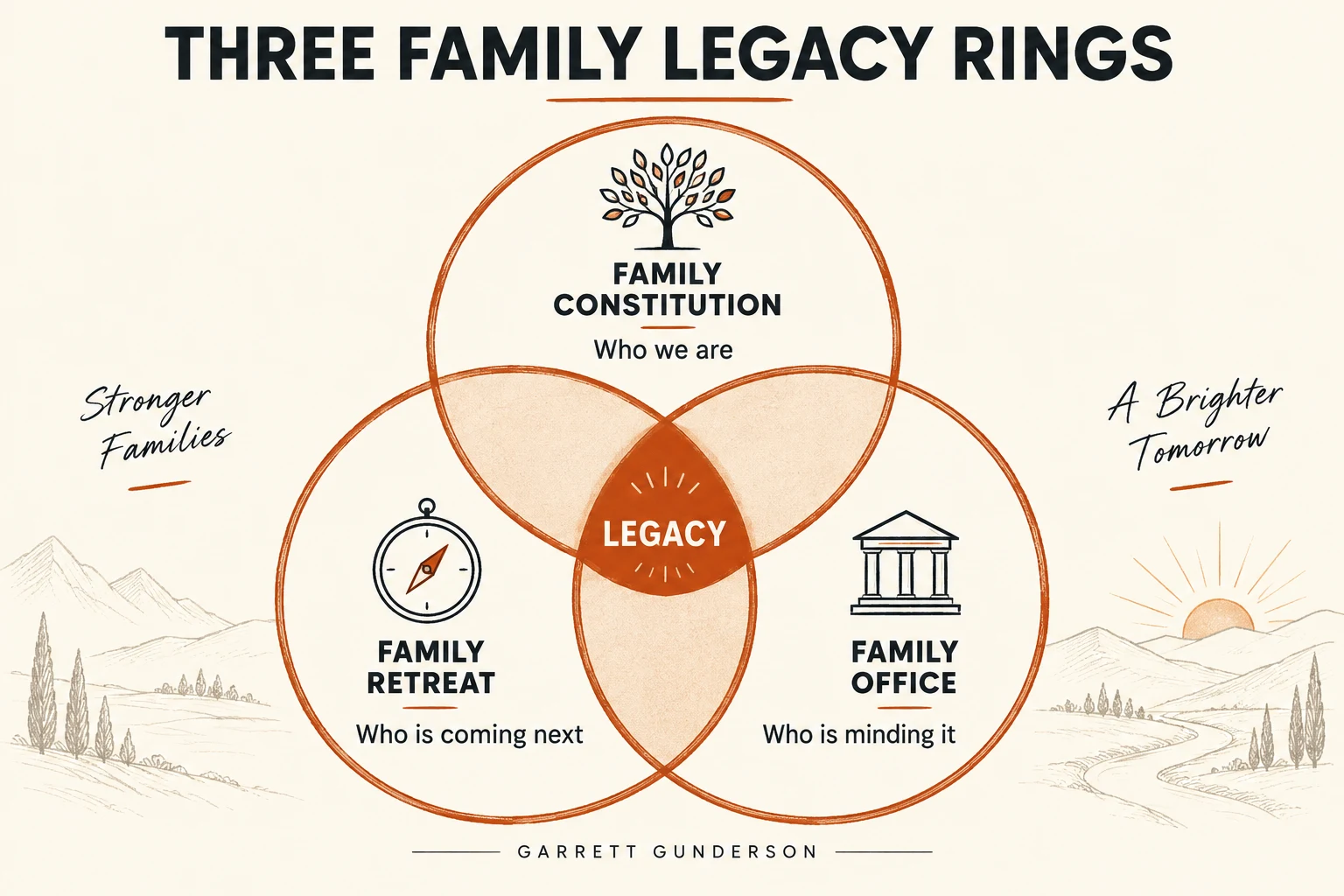
Three things. I call them the Three Family Legacy Rings, and every family whose generational wealth outlived them has some version of all three.
-
A Family Constitution. What this family believes, how decisions get made when you are not in the room, and the stories that carry it. This is your family governance, in your own words, leaving behind guardrails and breadcrumbs of prosperity philosophy.
Mine took years and went from 52 pages to 38 to 11. Yours doesn’t start at 52 pages. It starts with three sentences: what this family believes, who decides, and what the money is for.
- A Family Retreat. Where the next generation learns before it inherits. Three parts. Rituals, the small repeated things that build habits in your heirs, and ours are daily. Traditions, which pull everyone into the same room, and ours are semi-annual, plus nights at the cabin. And symbols, like our family crest.
-
A Family Office. Where the coordination lives, so none of it depends on one person’s memory. Fractional means you share a team instead of hiring your own. Virtual means they work with you remotely.
Between them, this is now within reach of families who aren’t Rockefellers. If you want to see how that works and how you could benefit, this is the version I run: the Rockefeller Method side of Multiplier Family Office.
Constitution answers who we are. Retreat answers who is coming next. Office answers who is minding it. Miss one and the other two don’t hold. That’s the difference between the Vanderbilts and the Rockefellers in three words.
Do You Have To Be A Rockefeller?
No. An inn in a Japanese village has lasted 1,300 years without ever being wealthy.
It takes a structure, not a fortune. And it’s never too early or too late.
Jim Speer was a one man operation for nearly 50 years, working 60 to 70 hour weeks and reaching about 4 percent of his market. In his mid seventies he hired a COO, a CFO, a sales manager and a marketing firm. His sons came into the business.
It grew 10 times in three years. His wife Kathy, who hated the lack of order and couldn’t step away, is mostly out of it now and free to be a grandmother. He works on the family mission statement and the family crest.
I started my own version at 19, in June 1998. Before I was married. Before I had kids. It was $50 a month.
Your heirs get a heritage, not just an inheritance. That’s building a living legacy. Preserve, protect and perpetuate, instead of the default everybody else runs.
This doesn’t take a billion dollars. It takes a decision and a structure.
The answer to how long generational wealth lasts is not three generations. It’s however many you build for.
So here is my question. If you died this year, which of the three rings does your family already have? Constitution, retreat, or office.
Find out which ring to build first
If you are a business owner making around $350,000 a year or more, my team does a free discovery session.
We ask questions and show you where the leaks and the gaps are. If we can help, we build you a personalized Report of Findings. Nobody sells you anything on the first call.
In prosperity,
Garrett Gunderson
Frequently Asked Questions
What is the shirtsleeves to shirtsleeves rule?
It’s the American version of an observation almost every culture made independently, from clogs to clogs in England to rice paddy to rice paddy in Japan. The mechanism underneath it is the third generation.
The first pays for the money, the second watches it get built, and the third receives it as a fact about the world rather than a result. That’s what makes it a predictable failure rather than a curse.
How often do families hold a family retreat?
Often enough that the next generation learns before it inherits. The Rockefellers gather more than 270 family members twice a year at Pocantico, and members are invited in at 21.
The retreat is where the rituals, the traditions and the symbols get taught. What it takes is a standing date the whole family plans around.
What is the difference between a family constitution and a will?
A will says who gets what. A family constitution says who you are, how decisions get made when you are not in the room, and what the money is for.
Howard Hughes died without a valid will and it cost 34 years of court and 22 cousins. The Vanderbilts had wills. What they didn’t have was anything holding the money together after it was divided.
How much money does it take to start a family office?
Far less than it used to take. A family office is one team handling your tax, legal, investment and insurance decisions together instead of four firms that never speak.
Fractional and virtual versions mean you share that team rather than hiring your own. The Hoshi inn in Japan has lasted 1,300 years and was never wealthy. It takes a structure, not a fortune.