
There are seven keys to building wealth through investments, and most people use one. Am I saying the other six are secrets? No. They’re just never taught together.
- Measure cash flow before net worth. Financial independence means the cash flow from your assets covers your lifestyle.
- Invest aligned with your Investor DNA, which means where your knowledge and relationships already give you an edge.
- Manage the risk you can influence, and mitigate the rest, which means limit the damage.
- Judge every return after tax.
- Own assets that pay you in three dimensions.
- Own what leads when prices rise.
- Make your money on the buy.
Most people own investments that can only make money one way. The thing goes up, or you made nothing. The wealthy own investments that pay them three different ways at the same time. Two of those ways work even when the market doesn’t.
Below: the seven keys in order, and the one question to ask before any deal. Plus the three-question test that separates a one-dimensional bet from a three-dimensional asset. Here’s what all that means and how it works.
Is Financial Independence a Number or a Cash Flow?
It’s a cash flow. Financial independence is simple: your monthly expenses, minus the monthly cash flow your assets pay you. Whatever’s left is the gap. That gap is the number that matters.
−
=
Net worth is a fine thing to know and a terrible thing to chase. A balance doesn’t pay for anything. You can be a millionaire on paper and poor in life. That’s the whole case for cash flow over net worth.
A net worth statement is a photograph. Cash flow is a pulse. One tells you what things were worth on a Tuesday. The other tells you whether you’re work optional.
Tonight, write your monthly expenses on one line and what your assets pay you on the next. Subtract. That’s your gap, and every investment gets judged on whether it closes it.
If you want to get even more precise, upload your statements to Claude or ChatGPT. Categorize them while you’re at it.
Want a faster read on which of your assets pay you? Run the free Income Asset DNA tool at X1 Wealth.
What Is Investor DNA, and Why Does It Matter More Than the Deal?
Risk is not in the investment. Risk is in the investor. The same deal makes one person money and costs another everything, and nothing about the deal changed.
Your Investor DNA is where your knowledge, relationships, and desire to learn already live. Four parts: your values, your drivers, your competencies, and your focus. A deal that doesn’t match all four is a distraction, even when it makes money for somebody else.
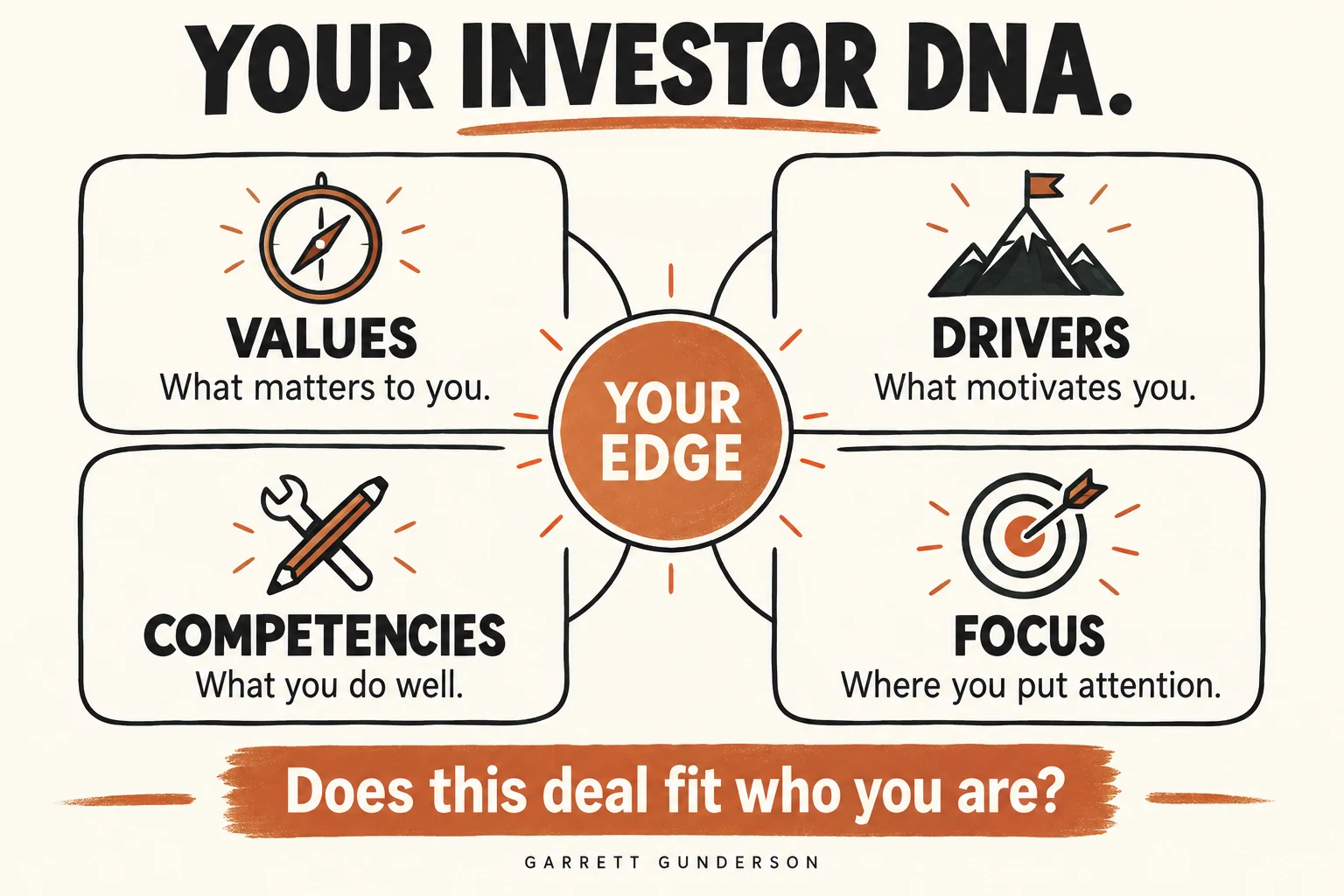
80 percent of what you think you have to know about investing is a distraction. Investing outside your zone isn’t diversification. It’s investing where you have no edge.
Warren Buffett borrowed this from Ted Williams, who hit .400 by only swinging at pitches in his sweet spot. Investing is better than baseball, Buffett says, because there are no called strikes. Thousands of pitches go by.
You swing at the one you understand, at a price you like.
If you’re an entrepreneur, the best investment is usually your own business. It always has been. You know the customers, the numbers, and the levers.
One question before any deal: does this align with my Investor DNA? If the answer is no, the return doesn’t matter.
Can You Manage Risk Instead of Just Tolerating It?
Yes, and it’s the whole difference between investing and gambling.
Managing risk means you can influence the outcome. Mitigating risk means you reduce the damage when you can’t. You manage it by knowing more, having areas of influence, and being able to act.
You mitigate it with structure, insurance, reserves, terms, and collateral. Collateral is an asset that backs the deal, so you get something back if it fails. A trailing stop loss is a term.
It’s a standing order that follows a price up and sells if it drops below a set amount.
Risk tolerance is a lie.
How much risk are you willing to take? If you’ve been taught that risk equals return, you say I’ll take it. Then you lose the money. Ask again and the score isn’t the same. Nothing about you changed. You just found out what the question was really asking.
A commercial pilot doesn’t have a risk tolerance. They have training, instruments, a checklist, and a route around the weather. Nobody asks how much crashing they’re comfortable with.
Most losses come from buying a story instead of doing due diligence, which is just the homework before money moves. Who do you know inside the company? What do the financials show? If you don’t know, it’s a gamble, not an investment.
And I’ve bought stories. I believed salespeople who didn’t know the details. They just created the excitement. This is how most people invest. Trust someone else. Put it somewhere you don’t understand, and hope it works out. Hope is not a financial strategy.
Why Do Two Investments With the Same Return Leave You With Different Money?
Tax.
The government doesn’t treat every dollar the same. Two investments with the same return can leave you with wildly different outcomes.
Ordinary income, which is just money taxed at the same rate as your paycheck, hits the highest rates. In 2026 that runs from 10 percent to 37 percent.
Long-term capital gains, the profit on something you held more than a year, are taxed at 0, 15, or 20 percent. If your modified adjusted gross income exceeds $200,000 single or $250,000 married filing jointly, a 3.8 percent net investment income tax may apply to some or all of your investment income.
Hold an asset a year and a day and the rate changes. That’s a return you get for patience.
And there’s a 0 percent bracket for long-term gains that most people never use. For 2026 it runs to $49,450 of taxable income if you’re single. It’s $98,900 if you’re married and file one return together.
Taxable income is what’s left after your deductions, the amounts you subtract before tax is figured. So the real number is higher than it looks.
If your taxable income before the gain lands under that line this year, some long-term gain may fit in the 0 percent federal bracket. Say you’re married and your taxable income is $70,000. That leaves $28,900 of room under the $98,900 line.
If you realize $28,900 of long-term gain in this simplified example, that gain could fit in the 0 percent federal capital-gains bracket. You could buy the asset back with a fresh, higher basis. Basis is just what you paid, and it’s the number your next gain gets measured from.
The wash sale rule only applies to losses, so this is allowed. That’s federal. Your state may still want a cut.
Judge every investment after tax. Before-tax numbers are marketing. Marketing misleads. A $100,000 gain as ordinary income at 37 percent leaves you $63,000. As a long-term gain at 20 percent, $80,000. Under the 0 percent line, all $100,000. Same return. Three different checks.
What Makes an Investment Three Dimensional?
An investment is three dimensional when it grows, pays you cash flow, and lowers your tax at the same time. This is the key to building wealth through investments that a one-dimensional planner never mentions.
Most investments give you one dimension: a dollar return. It goes up or it doesn’t. Compound interest is one dimensional too, interest on interest and that’s it.
And no, Einstein never called it the eighth wonder of the world, no matter what the financial planner tells you. A savings and loan ad coined that line in 1925. Nobody put Einstein’s name on it until the 1980s, decades after he died.
The tax advantage can come three ways. A deduction, a write-off in the year you invest. Depreciation, which is a yearly write-off for the asset wearing out, even while its value goes up. Residential rental property depreciates over 27.5 years under IRS rules.
A $275,000 building, not counting the land, gives you about a $10,000 write-off every year while the building itself goes up in value.
Or a tax-free exit on a capital gain asset. That includes the step-up in basis at death. Your heirs treat the value as whatever it’s worth that day, and the old gain disappears.
Buy a building for $200,000, hold it until it’s worth $1,000,000, and die owning it. Your kids’ number resets to $1,000,000. The $800,000 of gain never gets taxed.
Real estate and businesses are three dimensional. And two of those three dimensions, the cash flow and the tax advantage, keep working whether or not the market cooperates.
Ask three questions before you buy. Does it grow? Does it pay me? Does it lower my tax? Fewer than two yeses and it’s a one-dimensional bet.
What Beats a Paycheck When Prices Rise?
Assets.
When prices rise, wages chase them and assets lead them.
What holds up: anything with pricing power, which means you can raise the price without losing the customer. And anything that reprices quickly. Real estate with short leases. Self storage. Housing. A business that can raise prices this year.
Commodities and energy, which means raw materials like oil, wheat, and copper, because they’re the input causing the price rise. Farmland and timber: real, productive, and hard to make more of.
And the one almost nobody names: a long-term, fixed-rate loan against an asset that produces cash flow. You borrowed today’s dollars. You repay with cheaper ones while the asset reprices. Inflation is quietly paying down your loan. That’s a loan working as a tool, not a burden.
That only works if the asset covers the payments. A fixed-rate loan on something that doesn’t produce is just a bill.
What struggles: cash, and a paycheck.
Inflation is a current in the water. A wage earner is swimming against it. An asset owner is floating on it. Same water. Completely different day.
Look at your own list. Circle what reprices with inflation and what only chases it. If the biggest line is your paycheck, that’s the first thing to fix.
When Do You Really Make Your Money on an Investment?
On the day you buy. You just don’t find out until later.
A great asset at the wrong price is a bad investment. A fair asset at a great price often isn’t. The purchase is the one moment that’s completely in your hands. Everything after it is patience or damage control.
Being selective means looking at a hundred deals and buying one. Most people evaluate one deal at a time, so they have no comparison. Say no often enough that your yes means something.
Buffett says a punch card with 20 slots, one per investment for a lifetime, would make you a better investor. Twenty. Total.
I’ve had so many one-time-only opportunities. The Facebook IPO, which means the day a company first sells stock to the public. SpaceX. The best real estate deal I’d ever seen. It turned out to have structural issues, which is exactly why it was cheap.
The rush is where things get lost. Stick to what you know. That’s Investor DNA again, the key that makes the other six work.
How Do the Seven Keys to Building Wealth Through Investments Fit Together?
Invest where you have an edge. That’s Investor DNA.
Buy right, because that’s the one moment that’s yours.
Look for more than one dimension, so you’re not depending on the market cooperating.
Judge it after tax, because that’s the only number you keep.
Manage the risk you can influence, and mitigate the rest with structure.
Own what leads when prices rise, not what chases them.
And measure all of it against the gap, not against a balance.
That’s the wealth acceleration model: more than one dimension, and every dollar doing more than one job. Not a hotter stock. A better filter.
Which of the seven are you using today, and which one would have changed your last decision?
To become a better investor, start with the myths
My New York Times bestseller Killing Sacred Cows shows you how to crush the money myths. Those myths keep you investing one dimension at a time.
In prosperity,
Garrett Gunderson
Frequently Asked Questions
Is cash flow or net worth more important?
Cash flow. Net worth is what you own minus what you owe, and a balance doesn’t pay for anything. Take your monthly expenses, subtract what your assets pay you every month, and whatever is left is the gap. Closing that gap is what financial independence means.
What is the 0 percent capital gains bracket for 2026?
Long-term capital gains are the profit on something held more than a year. For 2026 the federal rate is 0 percent up to $49,450 of taxable income if you’re single. It’s $98,900 if you’re married filing jointly. Married with $70,000 of taxable income?
If that $70,000 is your taxable income before the gain, you may have $28,900 of room for long-term gain in the 0 percent federal bracket.
How long do you have to hold an investment to pay long-term capital gains?
More than one year, a year and a day. Then the profit is taxed at 0, 15, or 20 percent instead of at your paycheck rate. A 3.8 percent net investment income tax may also apply when modified adjusted gross income exceeds $200,000 single or $250,000 married filing jointly.
What are the best assets to own during inflation?
Assets with pricing power, which means you can raise the price without losing the customer. They tend to lead rising prices while cash and a paycheck chase them. A long-term fixed-rate loan on an asset that produces cash flow helps too.
You repay with cheaper dollars, as long as the asset covers the payments.