
Because passive is not the absence of risk. It is the transfer of judgment to somebody who gets paid whether you win or lose. Wealth does not come from finding a better investment. It comes from becoming a better investor.
That is a skill, and skills compound faster than interest does.
Understand the difference between passive and durable. Recurring revenue still means you monitor and manage it to maintain it. Passive is a lack of action and a lack of activity. Paired with the hope that something for nothing works out.
I learned that the expensive way. Multimillionaire in 2007, back to zero in 2008. An $8 million drop, because I did not understand what I am about to walk you through. Risk is not in the investment. Risk is in the investor.
What Does Passive Actually Cost You?
Four lines you have heard your whole life. Set it and forget it. You are in it for the long haul. High risk equals high return. And diversification as the only risk tool, which mostly means diworsify.
Look at what that buys. SPIVA tracks active funds against their benchmark every year. Over a 10 year window, the share of large cap funds that lose to the S&P 500 runs around 85 percent. Higher in some reports.
So the pitch is to pay somebody to underperform a fund that charges almost nothing. And they collect in the good years and the bad ones. That is a separate argument from whether an index fund is where your money belongs, which is its own conversation.
Here is the part nobody says out loud. Nothing is truly passive unless you accept low returns, or you take risk without knowing why it pays.
Ask why anyone would pay you a lot of interest for your money. Risk. Ask why a Treasury pays less. Risk. The rate is the market telling you what it thinks.
Passive just means you stopped listening. And if you are only hoping the story is accurate, hope is not a financial strategy.
What Are The Three Engines That Actually Build Wealth?
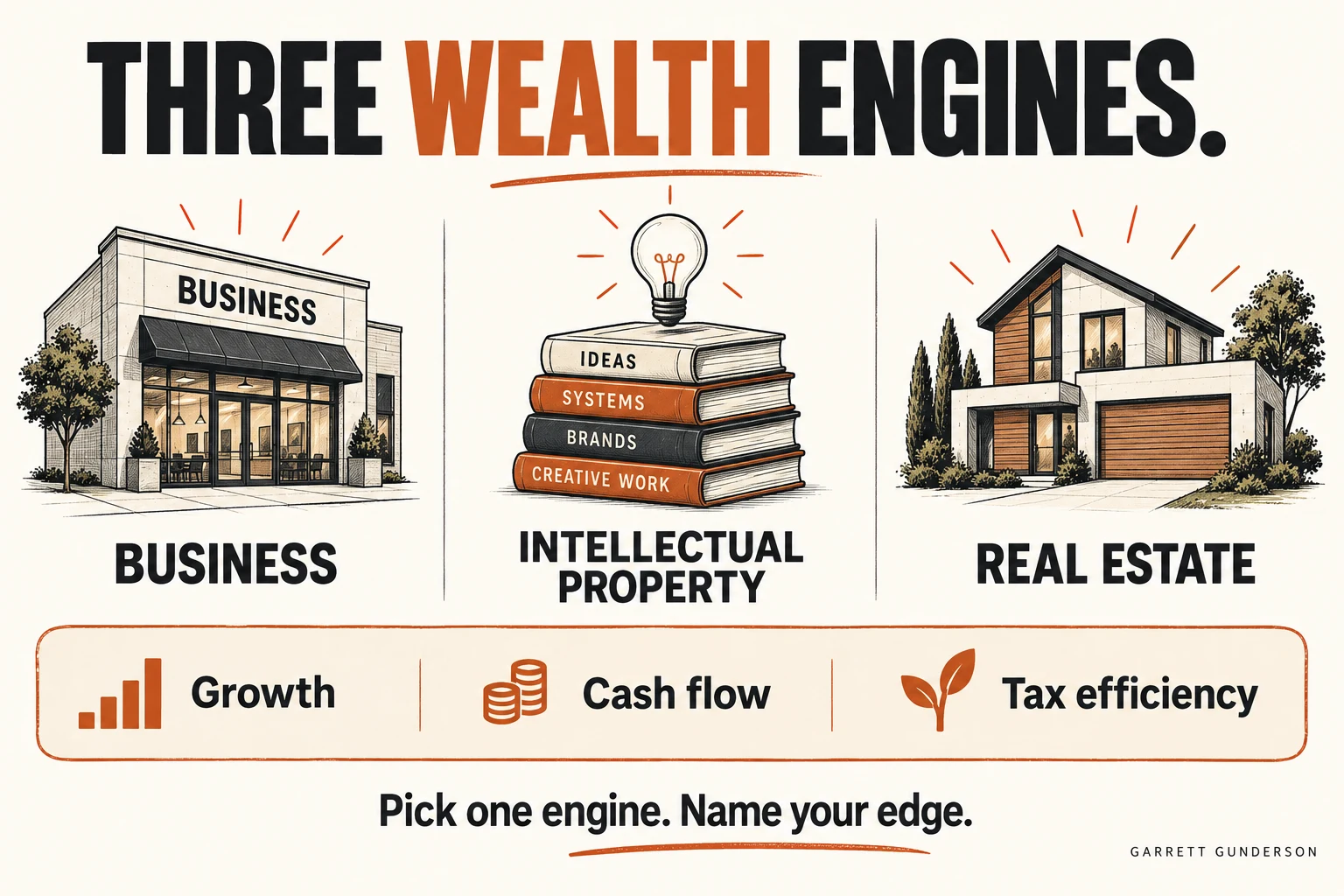
Business, intellectual property, and real estate. Almost everything else is a derivative of one of those three.
And a real investment has three dimensions. Growth, cash flow, and tax efficiency. Most of what gets sold to you has one. Growth only, and only if you sell. It defers tax rather than saving it, and pays you nothing along the way.
Which is why your primary residence is an asset and not an investment. It takes money from you every month. That is a lifestyle choice, and lifestyle matters, but do not count it as the plan. Some expenses are worth it. They are still expenses.
Recurring revenue is the game. My real estate is my 10 books now, not physical property. I invest in the business and build the recurring revenue. Then I keep one asset class outside it that does not move with the rest.
Capital gain assets are the quiet advantage. A married couple can sit at $98,900 of taxable income in 2026 and pay zero federal tax on long term gains. Or hold, borrow against it, and let the basis step up at death.
Either one beats trading hours for a salary.
Why Do Two People Get Opposite Results From The Same Deal?
Because the deal was never the variable. Investor DNA is.
It is three things. What you already know. Who you already know. And what you can actually influence. Almost everyone has an edge somewhere and has never named it, so they invest outside it.
A guitar, a piano and a set of drums. None of them is objectively the best instrument. The question was never which instrument. It was who is holding it, and who is skilled at playing it.
I passed on SpaceX. I passed on Facebook at the IPO. Not because they were bad companies, obviously, but because I was not in the know on either one. No edge, no information, no influence.
They would have distracted me from my business, taken time from my family, and had me carrying risk while uninformed. Investing has an opportunity cost and almost nobody prices it.
Instead I bought a second cabin and rented it out. Same area as my existing one, a three year rental contract, low maintenance. I know that area, so I could make an informed choice.
I paid $880,000 for the land. It sits on 3.25 acres with water rights, a fish pond and a cabin. At the time I wrote this, it was listed at $2,900,000. Listed, not sold, and that distinction matters in an article like this one.
The timing was not genius either. 2020 brought quantitative easing and people leaving cities. What I brought was minimal time drag and an understanding of the opportunity in front of me.
Same investor, opposite decisions, and the difference was never the asset.
Concentration builds wealth. Diversification protects it. In that order, and almost everyone runs it backwards.
Where Does The Money To Start Actually Come From?
From the money already passing through your hands. Four leaks: tax, interest, investment fees, and insurance you are overpaying for.
That is 10 to 20 percent of what most people make, every year. None of it arrives as a bill. It just never shows up.
When I learned cash recovery, the first thing it did was get me $91,000 back from the IRS. We found another $200,000 for a client recently.
A dollar you stop losing can be worth more than a new dollar you have to earn. What happens at tax time depends on what you recovered.
That is also why I keep saying you are the asset. Human life value is the capacity to produce. It is the only holding that responds directly to what you learn. Skip investing in yourself and your future runs on facts you do not touch.
What Rules Do The Families Who Keep It Actually Run On?
Four, and none of them are exotic.
- Make the money on the buy. That is the only moment you decide anything.
- Cash flow first. Appreciation is a bonus, not a plan. Cash flow is what buys you the right to be wrong about timing.
- Tax free forever is not tax deferred. Those get used interchangeably and they are not close. Tax and distribution diversification can raise future cash flow by 30 percent or more, and almost nobody plans for it.
- Manage risk and mitigate it, separately. Management is your own knowledge and influence: do you understand this, can you affect it. Mitigation is structure: collateral, a personal guarantee, a UCC filing, a trailing stop. Most people do neither and call it risk tolerance.
How Do You Tell A Real Investment From A Good Story?
Ask how it makes money and explain it in one sentence. If you cannot finish the sentence, or it takes a paragraph, it is not an investment.
The stories that separate good people from their money always sound excellent. A compelling narrative with no reality and no system to deliver it. Returns quoted with no explanation of where they come from. Urgency you did not create.
Watch for the energy going up alongside the price, with everybody talking about it at once. That pattern has a name and it is older than any of us. The higher the emotion, the lower the financial IQ.
So before money moves, four questions. How does this actually make money. What has to be true for it to work. Does it match my Investor DNA. And who gets paid if I lose.
That last one is the one people skip, and it is the one that tells you the most.
A general contractor once told me about his poorly performing real estate investments. We walked through the details, asked some questions, and looked at where the money was actually going. Entertainment, and the promoters of the deal.
It was off to a bad start before it started. And this was somebody who knew better, if he had looked. He bought the story, the network and the spectacular events instead, and let all of it override the logic.
So What Do You Do On Tuesday?
That is the real problem, and it is why an article like this only gets you partway.
You can agree with every word above and still be stuck on Tuesday, when the question is about your situation. Your entity. Your deal. Your parents. The thing your advisor said that did not sit right.
Those questions do not show up while you are reading. They show up later, and they are specific, and that is when most people quietly go back to doing nothing.
So start without me. Pick one engine. Name your edge. Find one leak this week.
And here is my question for you. What is the one thing you own right now that costs you money every month and produces nothing? That is where I would start.
Where the Tuesday questions get answered
I built Wealth Builders Club for exactly that gap. For now it is $65 a month. I am in there Monday through Friday answering questions, posting, and sharing the models I actually use. Live Q and A twice a month.
And a monthly hot seat, where somebody brings their toughest situation and we work through it in front of everybody. You learn due diligence by watching it happen.
You do not have to be wealthy. You do not have to be broke. You get to show up exactly how you are.
In prosperity,
Garrett Gunderson
Frequently Asked Questions
Is passive investing actually risky?
It carries a risk most people never price. You transfer judgment to someone who gets paid whether you win or lose. Nothing is truly passive unless you accept low returns or take risk without knowing why it pays.
The interest rate on anything is the market telling you what it thinks of the risk. Passive means you stopped reading that signal, not that the signal went away.
What is Investor DNA?
Three things: what you already know, who you already know, and what you can actually influence. It is the reason two people get opposite results from an identical deal.
Almost everybody has an edge somewhere and has never named it, so they end up investing outside it. Naming yours is what turns a guess into a decision.
Is your home an investment?
It is an asset, and it is not an investment. It takes money from you every month and produces no cash flow. That makes it a lifestyle choice, which is a legitimate thing to spend money on.
The mistake is counting it as the plan. A real investment carries three dimensions: growth, cash flow, and tax efficiency.
How do you tell if an investment is legitimate?
Explain how it makes money in one sentence. If you cannot finish the sentence, or it takes a paragraph, it is not an investment. Then ask three more. What has to be true for this to work. Does it match my Investor DNA.
And who gets paid if I lose. That last question is the one people skip and the one that tells you the most.
Where do you find the money to start investing?
In the money already passing through your hands. Four leaks account for 10 to 20 percent of what most people make every year. Tax, interest, investment fees, and insurance they are overpaying for.
None of it arrives as a bill, which is why it goes unnoticed. A dollar you stop losing can be worth more than a new dollar you have to earn. What happens at tax time depends on what you recovered.