
Most people think the most they can put away for retirement is about $24,000 a year. For a business owner, the real number can be $400,000.
The gap between those two numbers is a set of tax deferred pension and retirement savings plans almost nobody has heard of, and this is the whole menu: the plans, the 2026 limits, and where to open each one.
Am I saying you can stash $400,000 this year? Not exactly. But the ceiling is a lot higher than anyone told you.
What are the three tax buckets?
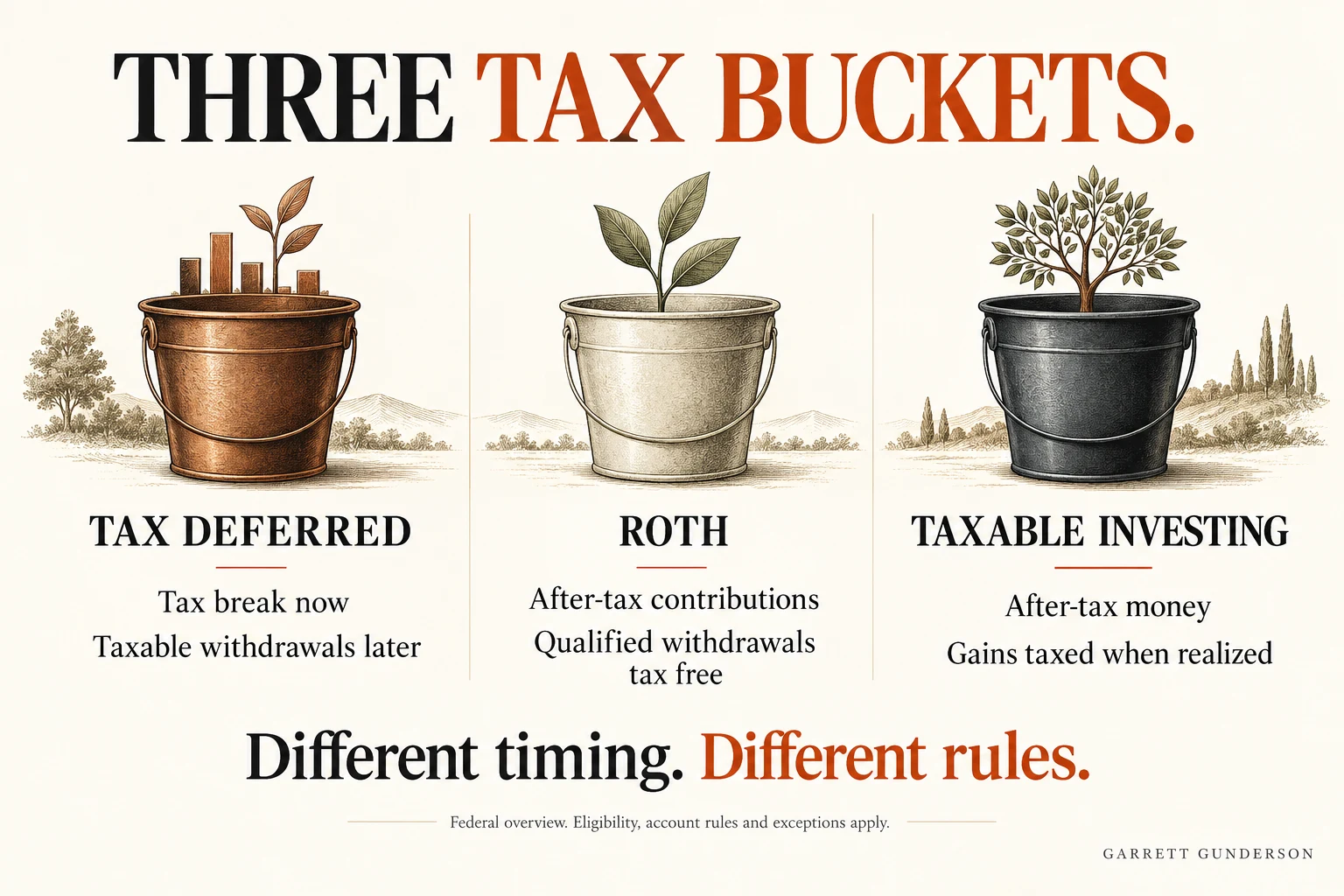
Every account you’ll ever hear about fits one of three buckets.
- Tax deferred: deduction now, ordinary income tax later, on everything including the growth.
- Tax free: no deduction now, nothing owed later.
- Capital gains: no deduction, but the growth is taxed at a lower rate when you sell, maybe even zero, and you can pass it on to your kids tax free.
Almost every working person owns bucket one and thinks that’s retirement planning.
Three buckets, three different sets of rules about when the government gets paid. Most people fill one bucket for 30 years and never look in the other two. Then they retire and find out the bucket they filled was the one with a bill attached.
Which tax deferred plan fits which person?
- Traditional 401(k): employer plans, the default for most working people.
- Solo 401(k): one person and a spouse, no other full time employees. The best tool most self employed people have never opened. Same bucket one rules apply, but the control and the Roth option inside it don’t exist anywhere else.
- Traditional IRA: anyone. Small limit, easy to open, and the deduction depends on your income and whether work covers you.
- SEP IRA: simple to run, but you fund employees at the same percentage as yourself.
- SIMPLE IRA: under 100 employees, and it requires an employer contribution.
- 403(b) for nonprofits and schools, 457(b) for government workers. The 457(b) has a feature the others don’t: no early withdrawal penalty once you separate from service.
What are the 2026 contribution limits?
| Plan | 2026 limit |
| IRA, traditional or Roth | $7,500, or $8,600 at 50 and older |
| 401(k), 403(b), 457(b) | $24,500 |
| 401(k) family, age 50 and up | $32,500 |
| 401(k) family, ages 60 through 63 | $35,750, and the window closes at 64 |
| Solo 401(k), employee plus employer | $72,000, more with catch-up |
| SEP IRA | Up to $72,000 |
| SIMPLE IRA | $17,000 |
| Cash balance and defined benefit | Six figures, sometimes several hundred thousand |
What changed about catch-up contributions in January 2026?
If you made more than $150,000 in wages from your employer last year, your catch-up contribution is no longer a deduction. It must go in as Roth. You pay the tax now.
It applies to 401(k), 403(b), and 457(b) plans, and almost nobody was told.
Two exceptions that matter. Partners and sole proprietors don’t have wages for this purpose, so they can still go pre-tax. And SEP and SIMPLE plans aren’t subject to the rule at all.
Which means how you pay yourself now changes whether your catch-up is deductible. Worth a conversation before your next payroll run.
How does a business owner put away $400,000?
Defined benefit and cash balance plans are how the $400,000 number happens.
The contribution is set by an actuary, which is just a specialist who calculates it from your age and income. Older and higher earning means a larger deductible contribution.
The catch is the commitment. You’re expected to fund it in good years and bad, for at least 3 to 5 years, and you fund some or all employees too.
This isn’t a do it yourself plan.
And before you set one up, ask whether deferral is even the right move. We recently stopped a business owner from opening one.
Instead of deferring $200,000 of income to save around $65,000 today, with the bill waiting tomorrow, we found $155,000 of real tax savings using R&D credits, amending the returns.
An R&D credit is basically just a tax break for money a business spends improving a product or a process. Those dollars never have to be paid back.
There are better ways than deferral, and it’s worth checking before you sign the actuary’s paperwork.
What goes in the tax free bucket?
- Roth IRA and Roth 401(k): taxed once, never again, and no required distributions on the Roth IRA.
- An HSA, which is just a health savings account: the only account untaxed going in, growing, and coming out for medical costs.
-
Properly structured, optimally funded whole life insurance: grows without an annual tax bill, access through basis, which is just the money you’ve paid in, then through loans. The death benefit passes income tax free.
The rules are the same for other kinds of insurance, but most of those carry risks most people don’t understand. This is a place to store and save, not something to compete with your investments.
Notice what none of these do. None of them convert your capital gains into ordinary income.
That’s exactly what an IRA would do to your real estate: convert the gain to ordinary income, remove the option to take depreciation, and remove the ability to pass it to the next generation tax free. A bad move and a bad plan for a capital gain asset.
Where do you open a retirement plan without paying a fortune?
- Solo 401(k): Fidelity and Schwab charge no setup fee and no annual fee. Here’s the tradeoff: Fidelity’s solo plan doesn’t offer Roth deferrals or loans. If you want both, E-Trade offers them with no setup fee.
- SEP and SIMPLE: any major brokerage. Easiest to open, cheapest to run.
- Cash balance and defined benefit: you’ll need a third party administrator and an actuary in order to run one. Ask exactly what the fee includes before you sign.
Provider terms change, so verify the current fee schedule before opening anything.
And if you’d rather have help than homework: my partner has the expertise and the licenses for all of this, without the steep 1 percent fiduciary fee that robs your return and stalls the performance.
A flat fee, education, and the resources, so you end up a better investor with more money in your investments. That’s the new way to manage money.
What goes in the capital gains bucket?
A regular brokerage account isn’t the loser everyone treats it as. It keeps the lower capital gains rate, and it has no rules about when you touch your own money. That access is the point. Cash flow beats a big locked-up number every time.
A married couple can realize just under $100,000 of capital gains per year without tax. A retirement plan ruins that possibility for your index funds or individual stocks, because growth inside a deferred plan comes out as ordinary income, at your highest rate.
Why is owning all three buckets the actual answer?
Own all three. Nobody knows what rates will be in 20 years, including the people who tell you they do.
Deferred works best when your rate today is high and will genuinely be lower later. It’s a rough deal for young people and for anyone whose income keeps growing.
Tax free works best when you have runway. Watch the restrictions and the lack of cash flow.
Deferral sounds great, until the required minimum distribution arrives. An RMD is the amount the government makes you take out each year, with a penalty if you don’t, plus the tax.
My grandma was mad when this happened to her at 70.5, the trigger age back then, because it increased the tax on her Social Security income.
And she hated paying tax even more as she got older and inflation kicked in, requiring more money to live the same lifestyle.
For some retirees the RMD age is 73; for those born in 1960 or later it is 75. The bill still comes. The idea that deferral always wins is a Sacred Cow, and it gores you right when you can least adjust.
Nobody would build a business with one customer and call it diversified. Three tax buckets is the same idea, pointed at a future nobody can predict. You’re not guessing which one wins. You’re making sure you don’t lose either way.
For the bigger picture, watch my free Wealth OS training.
Get a personalized Report of Findings
Everything above is the menu. Which plans belong in your plan depends on your income, your entity, your team, and what you’re building.
If you’re a business owner with more than $350,000 of revenue (revenue, not profit), my team will get to know you on one call: where you’re set, where you’re not, where the leaks and quick wins are.
No one sells you anything on the first call. If we can help, we build your personalized Report of Findings and show you exactly what to do next.
Book a discovery call → Learn more, be heard, and find out what’s working and what can be improved.
In prosperity,
Garrett Gunderson
Frequently Asked Questions
What is the maximum retirement contribution for 2026?
$24,500 for a 401(k), 403(b), or 457(b), rising to $32,500 at 50 and $35,750 for ages 60 through 63. A solo 401(k) or SEP IRA reaches $72,000, and a cash balance or defined benefit plan can reach several hundred thousand, set by an actuary from your age and income.
What is the mandatory Roth catch-up rule?
Starting January 2026, if your prior year wages from that employer topped $150,000, catch up contributions to a 401(k), 403(b), or 457(b) must be Roth: no deduction, tax paid now. Partners and sole proprietors are excepted, and SEP and SIMPLE plans aren’t subject to it.
What is a cash balance plan?
A defined benefit style plan where an actuary sets a deductible contribution from your age and income, sometimes several hundred thousand dollars a year. It requires consistent funding for at least 3 to 5 years, covers some or all employees, and isn’t a do it yourself plan.
Do retirement plans turn capital gains into ordinary income?
Yes. Growth inside a deferred plan comes out as ordinary income at your highest rate, even if it would have been a capital gain in a regular account. That’s also why holding real estate in an IRA gives up depreciation and the ability to pass the gain to your heirs tax free.
What age do required minimum distributions start?
73 today, moving to 75 in 2033. The RMD is the amount the government makes you withdraw each year from deferred accounts, with a penalty for missing it, plus the tax on what comes out.