
For Labor Day, I gave my kids a gift.
Not something physical, and not something that tarnishes.
No wrapping.
No box to throw away.
It was a step in stewardship. The gift of helping them avoid the accumulation trap, the rat race, and of not getting stuck in labor (trading time for money).
What Did I Actually Give Them?
A brokerage account, and the job of learning to use it.
When they were teenagers, we explored Bitcoin together. They took half of their income and bought it on my Coinbase account. I bought them a cold storage wallet, which holds the keys offline where nothing on the internet can reach it. At 18 they set up their own Coinbase accounts.
That was phase one.
Asymmetric upside with real volatility and a real chance of losing it all.
Not a pure gamble, but not something to bet your life on either.
Phase one taught them what a violent price chart feels like when it is their own money. Phase two teaches them why a price moves at all, and it is a brokerage account at Schwab, set up through my business partner and investment advisor Moe Abdou.
Why Not a Roth IRA?
Because the part of a Roth you actually want is the part you cannot reach for decades.
You have probably been told a Roth IRA is the obvious move for a kid. There are worse ideas. I am not setting one up for mine right now.
Let me be accurate about why, because the usual objection is overstated. Roth contributions can be pulled back out at any age, tax free and penalty free, since contributions come out first. So it is not locked the way people say.
It is the growth that sits until 59 and a half, and only after five years. The growth is the part you actually want, and the growth is the part you cannot touch. Add no cash flow along the way, government-written rules, and limits on what you can own inside it.
And locked money is what forces a sale in a down year.
Lose 10 percent, gain 10 percent back, and you are still behind, because the gain lands on a smaller base. $10,000 drops to $9,000, and a 10 percent gain only carries it to $9,900. Climbing out of that hole takes 11.1 percent, not 10.
-
Starting balance
$10,000
-
After a 10% loss
$9,000
$10,000 × 0.90
-
Then a 10% gain
$9,900
$9,000 × 1.10
Climbing out of that hole takes 11.1 percent, not 10.
The case for a Roth is decent. My kids are in a low bracket now, so they could put cheap after-tax dollars in today and pull them out tax free in a higher bracket later. It is not off the table. It just sits behind a brokerage account.
I cashed out my own 401(k) in my 20s. The penalty was 10 percent, and the whole withdrawal got taxed as income on top of that, so the real bill ran north of a third.
I made that trade anyway, to reach my own money at 23 instead of at 59 and a half.
I would take a 10 percent loan that only charged year one, then was at zero from then on. I looked at the penalty the same way. Especially since that was the lowest bracket I have been in my whole life.
Why a Brokerage Account?
Because it teaches, it pays, and the tax treatment is better than people assume.
Sell a stock inside the first year and the gain is short term, taxed like ordinary income. Hold longer than a year and it becomes a long term capital gain.
In 2026, a single filer pays zero federal tax on long term gains until taxable income passes $49,450. But do not add the full $16,100 single-filer standard deduction for a child who can be claimed as a dependent. A dependent has a different deduction limit, and the kiddie tax can change the result.
One caveat almost nobody mentions. For a dependent full-time student under 24 who does not provide more than half their own support, unearned income above the applicable threshold can trigger the kiddie tax. For 2026, that threshold is $2,700.
My youngest just left for university, but that alone does not end the kiddie-tax rules. We will plan any gain harvesting around the actual dependency and support rules.
You can also borrow against the balance instead of selling, though the good pricing, a Pledged Asset Line off SOFR, takes at least $100,000 in eligible assets. At $100 a month that door opens later. A reason to build the account, not something to expect on day one.
Why Not Just Buy the Index and Walk Away?
I prefer the lower fee layer with an index, but an index teaches a kid nothing.
So, I like index funds better than managed funds. SPIVA, which is S&P’s scorecard comparing professional fund managers against the index they are trying to beat, is brutal on the pros.
As of year-end 2025, 85.6 percent of large cap funds trailed the S&P 500 over 10 years and 92.9 percent trailed it over 20 years, which is the longest window S&P publishes. So no reason to pay for active management, or to eat the tax on all that churn.
Now the fee math, and I want to be precise about who charges what. The index fund itself is nearly free. Vanguard’s VOO costs 0.03 percent. The 1 percent I am about to describe is the advisor layer sitting on top of it.
Put $100 a month into the S&P 500 for 40 years, using actual total returns from 1986 through 2025 with dividends reinvested, and you invest $48,000 and finish with about $743,000 before fees. Run the same 40 years with a 1 percent advisory fee and it finishes around $547,000.
You put in $48,000. The advisor collects $45,005. And it costs you roughly $196,000, because those fee dollars left the account and never compounded again.
That is before inflation, and I will be straight with you: in today’s purchasing power the $743,000 is closer to $251,000.
The market is a tool for taking money off the table once you have already gotten where you are going. It is not the tool that gets you there.
Isn’t the Index Already a Concentrated Bet?
Yes, and more than at any point in modern history.
I wrote about why I don’t invest in index funds a while back. The numbers have gotten more extreme since.
At the end of 2025, the top 10 stocks were 40.7 percent of the S&P 500’s total index weight, an all-time record, according to RBC Wealth Management.
That compares to about 19 percent of index weight in 1990 and roughly 27 percent at the peak of the dot-com bubble. Index weight just means that if a company is 8 percent of the index, 8 cents of every dollar you put in goes there.
Look at where the returns came from, per First Trust Advisors. In 2023 the S&P 500 returned 26.3 percent and seven companies produced 60.2 percent of it. In 2024 the index returned 25.0 percent and those same seven produced 53.7 percent.
In 2025 it returned 17.9 percent and they produced 42.5 percent. Only about 27 percent of the 500 companies beat the index in 2023, and again in 2024.
Then the turn.
In the first half of 2026, those same seven subtracted from the index return. The other 493 carried them.
My kids will watch these types of things happen. The kid on autodeposit won’t.
Both the picker and the indexer are making a concentrated bet. The picker knows it.
What Does a Hundred Years of Data Say About Picking Stocks?
That the winners are real, and they are brutally rare.
Hendrik Bessembinder at Arizona State has done the definitive work here.
In his 2018 paper in the Journal of Financial Economics, he found that out of 25,332 companies that traded in the United States from 1926 to 2016, just 1,092 of them, about 4 in 100, produced all $34.82 trillion of net wealth the market created above Treasury bills.
A Treasury bill is a short-term loan to the US government, the closest thing to a risk-free parking spot. Just 90 companies produced half of it.
His update, released in March 2026 and covering 1926 through 2025, is starker. Out of 29,081 companies, about 3.7 percent produced all $91 trillion. Just 46 companies produced half.
The rest of the picture: only 42.6 percent of individual stocks beat a Treasury bill over their own lifetime, the middle stock lost 2.29 percent across its entire life as a public company, and the single most common outcome was losing everything.
Say that carefully, because the popular version of this stat is wrong. It is not that 96 percent of stocks lose money. It is that the other 96 percent, added together, net out to roughly zero against a T-bill.
Andrew Carnegie is the argument on the other side. In 1885 he said to put all your eggs in one basket and then watch that basket. That is the case for concentration.
So Why Am I Doing It Anyway?
Because the return on this account is the education, not the money.
Bessembinder says his own research argues for owning the whole index instead of picking stocks. He is right about the math, and I am not putting my kids in individual stocks because I think they will beat him.
I am doing it because a kid who has to defend why he owns one company learns something a kid who owns all 500 never learns.
This is a teaching account, not their future. The dollars are small enough that a total loss is a lesson instead of a wound.
And showing them that the market can be an overhyped, over promoted form of investing. This is a step to them knowing how to handle money, discern truth from falsehood, and be exposed to different types of investing.
My wife and I raised our kids on the program and book “love and logic”. One of its core ideas is to let them learn consequences while the stakes are still small. That is exactly what this is.
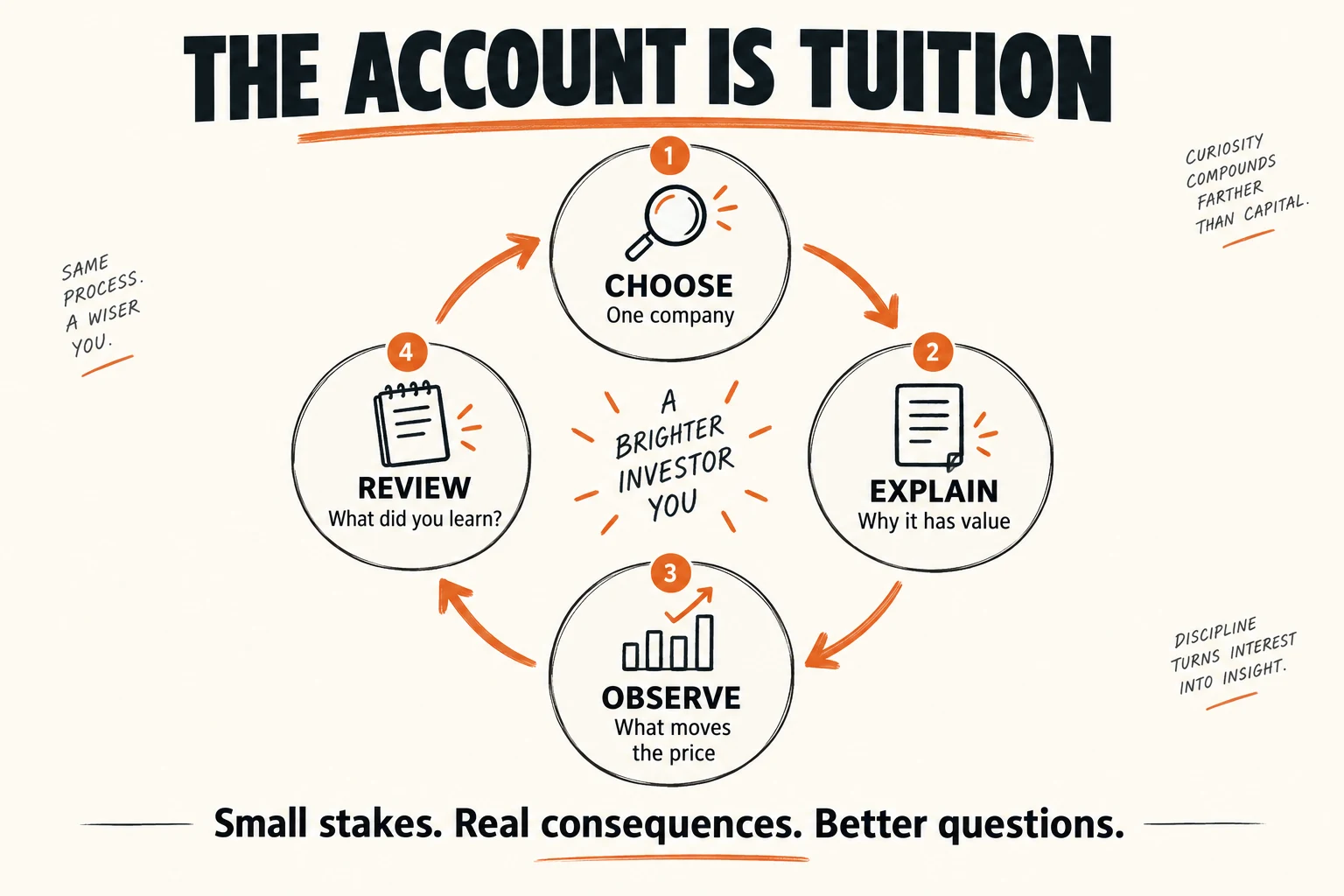
So they will pick companies, and they will have to answer real questions.
- Why would this company go up in value?
- What does it get right and what does it get wrong?
- How do you read a financial statement?
They will also learn that none of their analysis matters if the hype turns or a big institution sours and sells, and that if there is fraud it all goes down fast.
How Good Does Picking Actually Get?
Better than you think, and lower than you hoped.
The best-performing US stock of the last century was Altria. It compounded at 16.3 percent a year. The 17 best stocks of the century averaged 13.5 percent. The whole market did 10.1 percent.
So the single greatest stock out of 29,081 companies beat the market by about 6 points a year. That is the ceiling on being right.
Your own business can do that in a quarter. Run the numbers on your own kid. $500 a month for 10 years puts in $60,000 and, at the 10.1 percent the market actually did, leaves him about $43,000 ahead of what he put in.
Raise his income by $15,000 instead and he clears that in three years, then keeps it every year after. $500 a month in the market is using patience. $500 a month in yourself is something you can actually influence the outcome of.
Make, keep, grow, in that order. That is why I want them to invest in themselves more than in a ticker.
What About HSAs and 529s?
Both are fine tools. Neither was our tool.
I talked to my kids about a HSA (health savings account). In 2026 you can put in $4,400 pre-tax on self-only coverage or $8,750 on a family plan, let it grow tax free, and pull it out tax free for medical expenses.
But their taxes are low right now, so the deduction is not worth much yet. Later.
I told them about 529 plans and why their mom and I did not use them. We wanted fewer moving pieces, not more.
In fairness, 529s have loosened up a lot. Since 2024 you can roll up to $35,000 of leftover money into your kid’s Roth IRA, as long as the account has been open 15 years and they have earned income.
It is one tool. It just was not ours (too reliant on the market, higher fees).
We believe in maximizing wealth instead of fragmenting it. Simplicity is powerful. In my 20s I bought oil and gas, IPOs, a pile of real estate, and multiple businesses, and it got complicated.
In my late 40s I keep simplifying and pruning. But it was good to find out what worked and what did not. Some of it was expensive tuition. All of it stuck.
Where Does the Insurance Fit?
At the foundation, not at the return.
When our kids were 30 days old, we bought a properly structured, optimally funded whole life insurance policy on each of our sons. Over time we were able to pay them, put the money in tax free, and now it grows tax free.
They can access it, or rather we can, since our trust is the owner. Better than a savings account, a CD, or bonds. Safe, accessible, and it secured their insurability for life.
That started the Rockefeller Method in our family. Foundational pieces. Not where the return comes from. Where the protection lives.
Our kids are our greatest assets. If anything happens to them it is devastating emotionally and financially. Locking in insurance before their health changes matters too.
But that is not where they learn.
That is why Bitcoin, and now the brokerage.
One more piece of precision. When stock passes at death, the basis resets to its value that day, so the built-up gain never gets taxed as income. Notice I said income tax, not every tax.
Estates above $15 million per person, or $30 million per couple in 2026, still owe estate tax (unless using irrevocable trusts and other strategies). And that reset only happens at death. Hand shares over while you are alive and your original cost carries with them.
What Am I Really Teaching Them?
To become better investors and better humans, not passive pawns in somebody else’s game.
My oldest read Money Unmasked, did my book tour with me, and has filmed and edited more of my videos than I can count.
This is my process of educating him. Maybe more like indoctrination. We have been running quarterly family retreats this last year too, right up until our youngest left for university.
Here is the difference I keep coming back to. Old money prepares its heirs. New money works too hard and assumes it can make up for it later. New money loses through bad relationships and a thin network.
That was me in my 20s, and at more than one point since. My kids do not have to make all of the same mistakes. They also do not get to start on third base.
When I set up financial structures, I am thinking about opportunity along the way, not only at retirement. Not passive, mindless pawns in the financial game.
Ok, that seems a bit strong. There is nothing wrong with automation. I just prefer to automatically save and then deliberately invest. I do not think dollar cost averaging is the best method for my family, because we would like to be better than average.
Two people each hold a million dollars. One inherited it, one earned it. Completely different potential from that day forward. I do not want to hand my kids money. I want to help them grow the skills.
One last message I am leaving them with. The times I was most annoyed and inconvenienced to learn something, income statements in high school, reading investment statements in college, are the things that lasted.
I just wanted to go play or party. But hard easy leads to prosperity. Do the hard things now and life gets easier. Live easy now and it gets harder later.
Here is ten minutes of the actual conversation with my sons, unedited. Maybe a few of the Roth IRA things I said aren’t completely accurate.
I make more than is allowed to fund them and so, I wrote more accurately in this blog. But this shows exactly what I taught them on Labor day.
The advice you were handed was built for somebody else
Lock it up until you are 60. Max the 401(k). Buy the index and wait 40 years. Every one of those was sold to you by someone who profits when you follow it.
I took nine of those sacred cows apart in my first book, and I want you to have it free.
In prosperity,
Garrett Gunderson
Frequently Asked Questions
Is a Roth IRA a good idea for my kids?
A Roth IRA is not a bad account. My kids are in a low bracket now, so they could put cheap after-tax dollars in today and pull them out tax free later. But contributions are the only part you can reach early.
The growth sits until 59 and a half, there is no cash flow along the way, and the government writes the rules. It is not off the table. It just sits behind a brokerage account.
Do most individual stocks actually make money?
Most of them do not carry the market. Out of 29,081 US companies since 1926, about 3.7 percent produced all $91 trillion the market created above Treasury bills, and just 46 companies produced half.
Fewer than half of individual stocks beat a Treasury bill over their own lifetime, and the most common single outcome was losing everything. The winners are real. They are also rare.
How much can my child realize in capital gains tax free?
In 2026 a single filer pays zero federal tax on long term capital gains until taxable income passes $49,450. A child who can be claimed as a dependent has a different standard deduction limit, so do not add the full $16,100 single-filer deduction to that threshold.
The catch is the kiddie tax. For a dependent full-time student under 24 who does not provide more than half their own support, unearned income above $2,700 can trigger the kiddie tax in 2026.
How do I teach my kids to invest?
Give them small stakes and real consequences. We used love and logic, so a loss teaches while it is still cheap. Have them pick one company they can explain out loud, read the financial statements, and defend why it has value.
Then talk about what actually moved the price. The account is tuition, and the lesson compounds a lot longer than the money.