
No. A high deductible health plan is not a tax strategy. It is an eligibility requirement. The plan itself carries no special deduction. What it unlocks is a Health Savings Account.
That is the one account in the federal tax code that skips tax at all three points. Going in, growing, and coming out for medical costs.
A high deductible plan is a key, and most people holding the key have never opened the door. They take the plan for the lower premium. They open the account because HR told them to. Then they leave the money in cash. That is the whole mistake.
And as of January 2026, the plan may not even be required. Congress changed who qualifies, and almost nobody has caught up.
What Makes A Plan A High Deductible Health Plan?
The IRS sets the numbers, not the insurance company. It is not a marketing term.
For 2026 the deductible must be at least $1,700 for an individual and $3,400 for a family. Those were $1,650 and $3,300 in 2025.
The out of pocket maximum cannot exceed $8,500 for an individual or $17,000 for a family. Out of pocket counts deductibles, copays and coinsurance. It does not count premiums.
A plan has to satisfy both tests. Miss either boundary and it does not qualify, which means no HSA.
Preventive and proactive care is usually covered before you hit the deductible. That is allowed by design.
Is A High Deductible Health Plan Still Required For An HSA In 2026?
As of January 1, 2026, not always. Three things changed.
One. Bronze and catastrophic exchange plans now qualify. They do not have to meet the technical definition anymore. Congress declared them HSA compatible, and that opened the door for roughly 7.3 million people who were locked out before.
Two. Direct primary care no longer disqualifies you. Direct primary care is a flat monthly fee you pay a doctor’s office instead of running everything through insurance. Those memberships used to block your HSA entirely.
Now they do not. You can even pay the fee from the HSA. The cap is $150 a month per person, $300 for a family, both indexed for inflation.
Three. Telehealth before the deductible is permanent. Telehealth is care delivered by phone or video instead of in person. The pandemic rule had lapsed. Congress made it permanent for plan years beginning on or after January 1, 2025.
The three tax breaks did not change at all. What changed is who fits through the door.
The rule used to be that you had to take the hard plan to get the good account. Congress just widened the door.
Does A High Deductible Health Plan Itself Save You Tax?
Mostly no. The premium is a premium. Lower than a low deductible plan, but that is a price, not a deduction.
Through an employer, health premiums usually come out pre tax anyway. That is true of any plan.
Self employed? You can deduct health premiums. Also true of any plan.
So here is the straight answer. The plan is not the tax strategy. It is the eligibility requirement for the tax strategy. If you want the actual tax strategy conversation, it starts at the account.
Nobody buys a gym membership because the parking is free. The parking is not the benefit. It is what comes with being a member. The high deductible plan is the membership. The HSA is the reason you joined.
Why Is An HSA Different From Every Other Account?
Because it skips all three taxable moments instead of one.
- Money goes in without being taxed.
- It grows without being taxed.
- It comes out without being taxed, when you spend it on qualified medical costs.
Every other account gets you at one of those three points. A 401k taxes the way out. A Roth taxes the way in. This one skips all of them.
It is yours, not your employer’s. Change jobs and it comes with you.
And it is not a flexible spending account. An FSA forfeits whatever you do not spend by the deadline. Nothing in an HSA expires.
There are also no required distributions, ever. Nobody makes you take it out.
An FSA is a gift card that expires. An HSA is a savings account you happen to be able to spend at the doctor. People treat them the same, and one of them takes your money back.
How Much Can You Put In An HSA For 2026?
$4,400 if your coverage is just you. $8,750 for a family.
An extra $1,000 a year once you turn 55. That is the catch up contribution, and it did not change for 2026.
If both spouses are 55 or older, each one has to have their own account to make that catch up. One account cannot take two.
And you can contribute for last year right up until the tax filing deadline. That makes it one of the few tax moves still open after December 31.
What Can You Actually Spend HSA Money On?
- More than most people use it for. Deductibles, copays and coinsurance. Dental and vision. Prescriptions.
- Therapy and mental health. Chiropractic. Physical therapy. Fertility treatment.
- Over the counter medicine and menstrual products, with no prescription required.
- Long term care premiums, up to an age based limit.
What it does not cover is health insurance premiums, with narrow exceptions. COBRA, coverage while you are collecting unemployment, and once you are on Medicare, Medicare premiums but not Medigap. Medigap is the supplemental policy that fills what Medicare leaves.
Not cosmetic procedures. Not gym memberships or vitamins without a diagnosis.
After 65 you can spend it on anything. Non medical comes out taxed as ordinary income, with no penalty. At that point it works like a traditional IRA for everything else.
Why Is Most HSA Money Sitting In Cash?
Because of a threshold almost nobody notices. It is the biggest mistake on this topic.
Most administrators make you hold $1,000 to $2,000 in cash before they will let you invest anything. Money below that line earns close to nothing, and plenty of accounts never get above it.
That is the mechanical reason an account with three tax breaks ends up earning savings account interest. It is not a decision anybody made. It is a default nobody read. Saver or investor gets decided for you here.
Above the threshold you usually have mutual funds and index funds, and some administrators offer a full brokerage window.
Fidelity, Lively and HealthEquity come up most often for low fees and a real investment menu. Check the current fee schedule before you move, because those change.
You can also move an HSA. If your employer’s administrator is expensive, transfer it. That is not a taxable event.
Compare four things. The monthly maintenance fee. The cash threshold before you can invest. The investment menu. And whether there is a fee to transfer out.
What Is The HSA Receipt Strategy?
Nothing says you have to be reimbursed in the same year you spend.
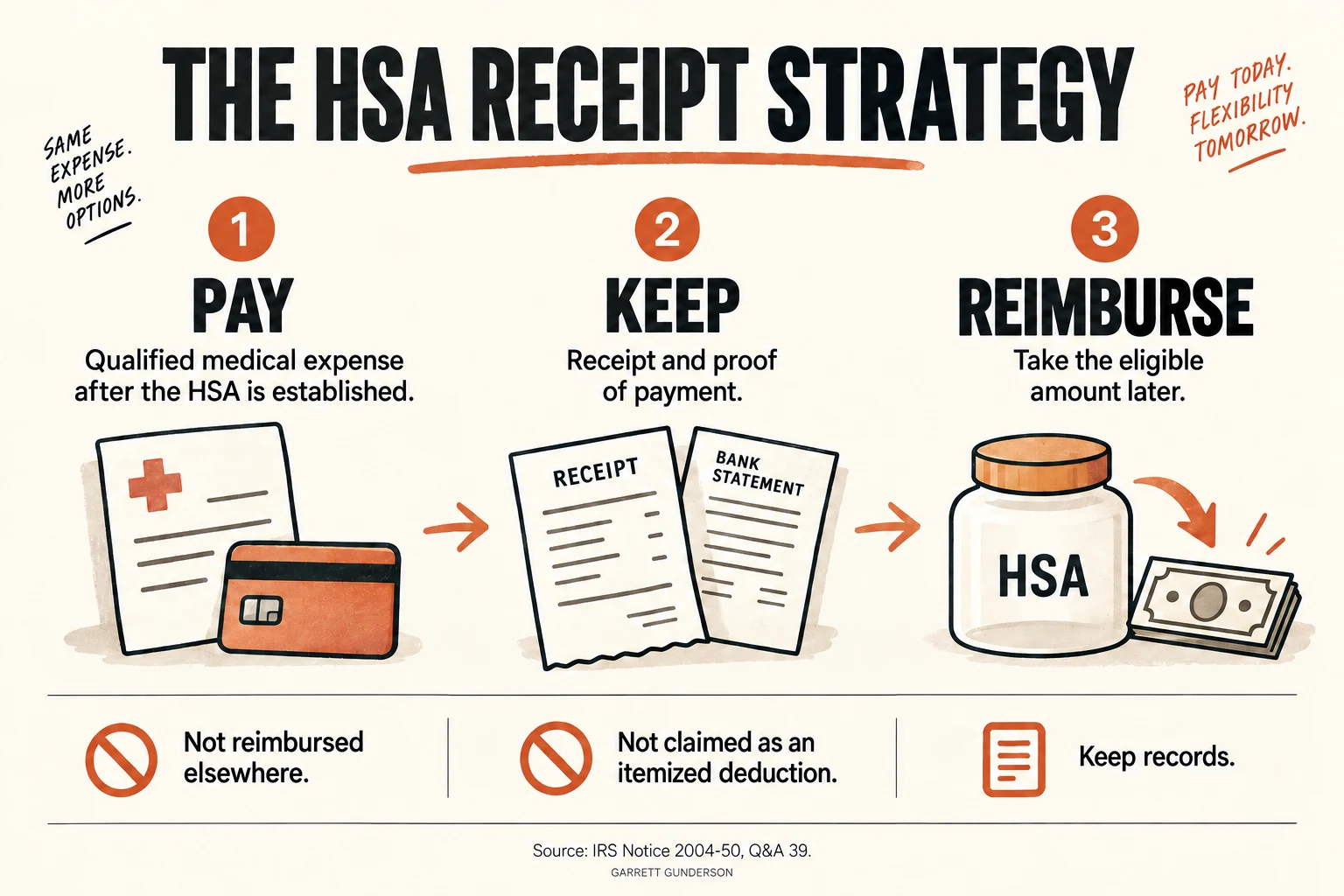
Pay the medical cost out of pocket now. Keep the receipt. Let the account stay invested and grow untouched.
Then reimburse yourself in 20 years, tax free, for a bill you paid today.
Two rules. Keep the records, and the expense has to come after you opened the account.
Every receipt you file away is a coupon that never expires. You are not saving paper. You are building a stack of tax free withdrawals you get to cash whenever you decide.
What Are The Downsides Of A High Deductible Health Plan?
They are real, and a few of them are expensive.
Medicare ends it. Enroll in any part of Medicare and you cannot contribute anymore. Contributing anyway triggers back taxes and excise taxes.
There is a six month lookback. If you enroll after 65, Part A can be backdated up to six months. So contributions have to stop before you sign up. This is the most common expensive mistake on this topic.
The early withdrawal penalty is steep. Before 65, a non medical withdrawal is taxed plus a 20 percent penalty. That is double the 401k early withdrawal penalty.
You have to have a plan for the deductible itself. A high deductible plan with an empty HSA is just exposure. That is a financial fitness question before it is an insurance question.
Two states do not follow along. If you live in California or New Jersey, your state does not follow the federal treatment. Contributions are not deductible there, and the growth inside gets taxed by the state every year.
And the inheritance rule, which is the worst feature of the account. A spouse inherits it as their own HSA. Anyone else gets the full value as taxable income in a single year.
So What Is A High Deductible Health Plan For Tax Purposes?
One thing. It qualifies you for the account. The account is where all of it happens.
Take the plan for the premium if the math works. Open the account because of the three tax breaks. Then invest it, keep your receipts, and leave it alone.
And remember what this is and is not. Tax is one leak. There are four, and most people lose 10 to 20 percent of what they make every year to the set.
Taxes, interest, investment fees, and insurance they are overpaying for. None of it shows up as a bill. It just quietly never reaches you.
A dollar you stop losing is worth about a dollar fifty you would have to go out and earn. The earned one gets taxed. The recovered one does not.
So here is my question. Is your HSA invested, or is it sitting in cash waiting for a copay?
Find the tax you are overpaying before you optimize anything else
I put together something called the Tax Navigator. It is free, and it opens with something that will change how you hear the word savings.
There are five different things people mean when they say they saved you $10,000. A deduction. A credit. An exclusion. A deferral. A refund. Those are not the same, and only some of them are actually savings.
Inside you get the four places I look for tax opportunities. The framework I use to review taxes every quarter instead of every April. And the questions to bring to your CPA, so you walk in ready.
In prosperity,
Garrett Gunderson
Frequently Asked Questions
What qualifies as a high deductible health plan in 2026?
A plan has to pass two tests, not one. The deductible must be at least $1,700 for an individual or $3,400 for a family.
The out of pocket maximum cannot exceed $8,500 or $17,000. Out of pocket counts deductibles, copays and coinsurance, but never premiums. Miss either boundary and the plan does not qualify.
Can you have an HSA without a high deductible health plan?
As of January 1, 2026, yes. Bronze and catastrophic plans bought through an exchange are now HSA compatible, whether or not they meet the technical definition.
That change alone made roughly 7.3 million more people eligible. A direct primary care membership also stopped disqualifying you. The fee itself became a qualified expense you can pay from the account.
Can you invest HSA money, or does it have to stay in cash?
You can invest it, and most people do not. Administrators typically require $1,000 to $2,000 to sit in cash first, and plenty of accounts never clear that line.
Above it you usually get mutual funds and index funds, and sometimes a full brokerage window. If your administrator is expensive you can transfer the account without triggering tax.
Is an HSA better than a 401k?
For the money you will spend on health care, it is not close. A 401k defers tax and collects it on the way out at ordinary income rates. An HSA skips tax going in, while it grows, and coming out for qualified medical costs.
It also has no required distributions and it travels with you between jobs. After 65 it behaves like a traditional IRA for anything non medical, so the downside case is a tie.
What happens to an HSA when you die?
It depends entirely on who inherits it, and this is the account’s worst feature. A spouse takes it over as their own HSA and nothing changes. Anyone else gets the full value as taxable income in a single year.
That can push a child into a much higher bracket, in the year they are already dealing with your estate. It is worth naming the beneficiary deliberately rather than by default.