
Yep.
A 401k is a qualified plan under the Internal Revenue Code, which just means the plan follows the government’s rules. It sits under section 401(k).
Your money goes in pre-tax or Roth, nothing gets taxed inside the account either way, and traditional dollars come out as ordinary income, taxed at your paycheck rate.
That’s the answer. But that isn’t the most important question. Nobody searches that exact phrase unless something about the account stopped adding up.
Why Are You Really Asking About Your 401k?
There are four reasons this question gets typed, and only one of them is about the tax code.
- One. You’re checking whether it blocks an IRA deduction. Being covered by a plan at work does limit that.
- Two. You’re filling out paperwork that asks if you’re covered by a retirement plan. Yes, you are.
-
Three. You’re wondering if it’s protected from creditors. That’s ERISA, the 1974 law covering workplace plans, and generally yes if it’s a real company plan with employees in it. Here’s the part that catches business owners.
A solo 401k, meaning a plan covering only you and your spouse, is not an ERISA plan at all, because the Labor Department says an owner and spouse aren’t employees. In bankruptcy you’re still fine. Against a lawsuit, you’re relying on your state’s law, and that varies enormously.
Four. You’re asking the real one. Is this thing actually good for me?
You are reading this as one of two people. The one who puts money in the plan, or the one who signs off on it. Some of what follows is only for one of you. I will say which.
What Does The Tax Code Actually Say?
Section 401(k) is a cash or deferred arrangement. If you run the company, that is the choice you give your team: take the money now as pay, or put it in the plan. If you work there, that is the choice you are being handed.
Nine more codes come with it.
You don’t have to memorize any of it. You do have to know that ten different sections govern this account, and you wrote none of them.
How Is A 401k Taxed?
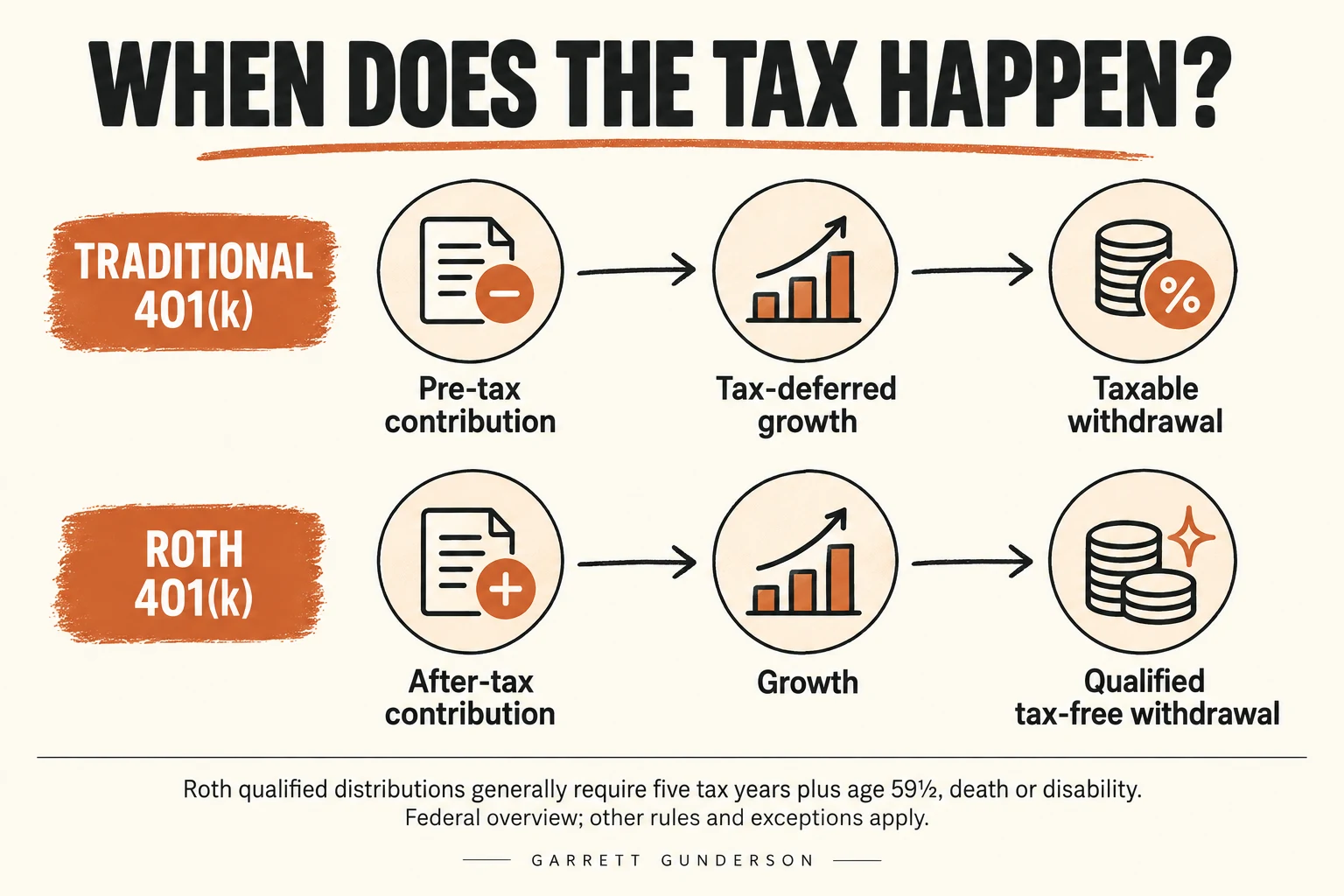
Traditional dollars go in before tax, grow with no annual bill, and come out as ordinary income.
That last part is the one people miss. Growth isn’t taxed as growth. It’s taxed as income. So every dollar your account earned gets taxed at your paycheck rate instead of the lower capital gains rate you’d have paid in a regular investment account outside the plan.
Roth 401k flips it. No deduction now, growth is free, and qualified withdrawals are free. Qualified means two conditions together, not either one: you’re 59 and a half, and the account has been open five years.
The employer match is pre-tax by default, and in most plans that’s still the only option. But SECURE 2.0 changed the rule in December 2022, so a plan is now allowed to let you take the match as Roth.
Three catches. The plan has to offer it, you have to be fully vested when it lands, meaning it’s actually yours and the company can’t claw it back if you leave, and you pay tax on it that year.
Does The New Roth Catch-Up Rule Apply To You?
It applies if your 2025 wages from that employer topped $150,000. Starting January 1, 2026, your catch-up contribution dollars have to go in as Roth. No deduction on them anymore.
That’s section 414(v), and the threshold is on FICA wages from that specific employer, which is box 3 on your W-2. If you’re self-employed with no W-2 wages, you’re not caught by it. If you take W-2 wages from your own S corp, you are.
The 2026 numbers, from IRS Notice 2025-67. You can defer $24,500. At 50 the catch-up adds $8,000, so $32,500. From 60 through 63 the catch-up is $11,250 instead, so $35,750, and it drops back at 64. The enhanced amount replaces the regular catch-up. It doesn’t stack on top of it.
When Does The Tax Bite, And When Does It Not?
It bites when you pull money out before 59 and a half, and it doesn’t bite when the money moves trustee to trustee, meaning the two companies move it directly so it never touches your hands.
Take it early and you owe income tax plus a 10 percent penalty. That penalty is section 72(t), and every exception lives inside it.
When somebody says they’re doing “a 72(t),” they mean substantially equal periodic payments: lock into a fixed schedule, skip the penalty, and stay stuck with it for five years or until 59 and a half, whichever runs longer.
The other doors out: separation from service in or after the calendar year you turn 55, disability that’s total and permanent, and unreimbursed medical above 7.5 percent of your adjusted gross income.
Read that 55 rule twice. It’s in or after the YEAR you turn 55, not at 55. The IRS publishes an example of a man who left at 49, waited until 55, took the money, and still owed the penalty.
It also only covers the plan at the job you just left, so roll it to an IRA first and you throw the exception away.
A direct rollover isn’t taxable. But if the check comes to you, 20 percent gets withheld and you have 60 days to redeposit 100 percent, including the fifth you never received.
Miss the difference and it’s a taxable distribution with a penalty. One phone call asking for a direct transfer avoids all of it.
Required minimum distributions, the age the government makes you start taking money out, begin at 73 if you were born between 1951 and 1959. Born in 1960 or later, yours start at 75. The Roth 401k no longer has them at all.
And a loan isn’t a distribution. Leave the job with one outstanding and the plan offsets it against your balance, and that offset is taxable. But you get a window almost nobody mentions.
You have until your tax return due date, including extensions, to move that amount into an IRA and erase the tax. Not 60 days. Leave in January and you have until October of the next year.
My aunt was mad when she had to pay income tax on every dollar she pulled out of my grandparents’ plan. The money was there to pay it with, so I didn’t think she had much room to complain.
But it could have been prevented if those assets had sat outside the plan and gotten a step up in basis at death, which just means the tax on all that growth dies with you. Plan dollars never get that. They come out as ordinary income to whoever inherits them.
What Rules Come With The Plan Itself?
This next part is for you if you sign off on the plan.
When you put money in the plan, it is FBO. For benefit of. You don’t make the rules, you abide by them, because the plan stops being only yours.
Nondiscrimination testing is a yearly math check making sure the plan isn’t mostly benefiting the highest paid people in the building. Fail it and the plan hands money back.
One of my clients said his plan failed that test year after year and handed back $10,000 to $15,000 of the contributions he had already planned to defer.
Top heavy is worse. Trip it when key people hold more than 60 percent of plan assets, and you owe minimum contributions for your whole team, planned for or not.
In a small company the owner often holds most of the balance, so this fires more often than expected. Safe harbor designs sidestep the testing by committing to a set employer contribution every year, a real cost traded for a real headache.
A solo 401k skips the testing, because there’s nobody to test against. It doesn’t skip the contribution cap, and it stops being a solo plan the day you hire an eligible employee.
As the business owner, you are also a fiduciary on that plan, which means you’re legally on the hook to put your team’s money ahead of your own convenience. That’s a legal standard, not a formality.
So Is A 401k Actually Good For You?
It’s one bucket. It isn’t a plan. That’s why I don’t fund one myself.
The match is money you don’t get any other way. But if you are the employer, ask whether it actually moves the needle and matters to your team more than other benefits or compensation.
If you are an employee, take it. The one asterisk is vesting, which is how long before the match is actually yours to keep, so ask what the schedule is before you count it.
Now the costs nobody puts on the enrollment form. Capital gains treatment is gone, so everything exits at your paycheck rate. The money is locked until 59 and a half.
You’re betting your future rate is lower than today’s, and nobody knows that. And if you own a business, capital inside your own company may return more than the deduction ever saves you.
My friends Jon and Missy Butcher, who built Lifebook, were doing everything the way they were told. Cutting back, saving, funding the plan. They stopped funding the 401k and went all in on the business instead.
Jon’s line stuck with me. “The 401(k) was only a fraction of our net worth, yet it was responsible for the majority of our stress.”
Are 401ks bad? They are if they are your whole plan. If they stress you out. If you struggle with cash flow. If you have better opportunities. A supplement at best.
It’s a partnership with the government. You get a deduction today. Government gets to write the rules for the next thirty years. Is that the partner you want? Is that the partner you trust?
Everything I just showed you is about the money going in. Before you optimize that, there’s a faster win, and it’s money you already earned. I call them the Four I’s.
Most business owners lose 10 to 20 percent of what they make every year to four things. Taxes. Interest. Investment fees. And insurance they’re overpaying for. None of it shows up as a bill. It just quietly never reaches you.
And here’s why that matters more than anything above. A dollar you stop losing is worth about a dollar fifty you’d have to go out and earn. Because the earned one gets taxed. The recovered one doesn’t.
For the bigger picture, watch my free Wealth OS training.
Want a second set of eyes on the whole picture, not just the plan?
If you run a business doing $350,000 a year or more, my team will put together a personalized Report of Findings for you.
We look at where tax is leaking, what your loans actually cost, what the plan is doing for you against what it’s doing to you, and what a coordinated structure looks like in your situation. Nobody sells you anything on the first call.
In prosperity,
Garrett Gunderson
Frequently Asked Questions
Can I contribute to a 401k and a traditional IRA in the same year?
Yes. Being covered by a plan at work never blocks the contribution itself. It only phases out the deduction on the IRA side once your income passes the limit.
So the money can go into both. Whether you write off the IRA piece depends on your income and your filing status that year.
What happens to my 401k when I die?
It goes to whoever is on the beneficiary form, and that form beats your will. In a 401k your spouse is the automatic beneficiary unless they signed a waiver.
A spouse can roll it into their own IRA. Most other beneficiaries have to empty the account within ten years, and every dollar comes out as ordinary income.
How much can I put into a solo 401k as a business owner?
Two hats, one cap. You defer up to $24,500 as the employee in 2026, then the business adds a profit sharing contribution on top.
Both together stop at $72,000, or 100 percent of your compensation if that is less. Catch-up dollars sit above the cap: $8,000 at 50, and $11,250 from 60 through 63.
Is the employer match worth staying at a job I do not like?
The match is real money and you do not get it anywhere else, so take it while you are there. It is not a reason to stay.
Check the vesting schedule before you count it as yours, because unvested match goes back to the plan when you leave. A few thousand dollars a year rarely prices a life.